

Cross Border Ecommerce Fulfillment Between HALTON HILLS ONT And Buffalo NY – The Top 8 Trends
Cross-border ecommerce fulfillment between Halton Hills, Ontario, and Buffalo, New York, is the coordination of inventory storage, order processing, and shipping across the U.S.-Canada border. If you sell to U.S. shoppers from a Halton Hills or west-GTA store, you know the pain of slow deliveries and rising costs. The right HALTON HILLS ONT ecommerce fulfillment & 3PL services setup can ease both.
The short answer is to keep shipping from Ontario while U.S. demand is low or uncertain, then price out Buffalo stock once demand is steady. Since Aug. 29, 2025, goods worth US$800 or less sent outside the postal network are subject to all applicable duties and need full customs clearance. A rough screening range for the switch is 500 to 1,000 U.S. orders a month, but only a full-cost comparison can confirm it for your business.
This guide shows you how to run that comparison, explains eight trends as plain moves you can make on this lane, and lists what to have ready when you call 716-823-2142 for a quote. You can also follow Canadian logistics industry news to see how the 3PL market keeps changing.
Key Takeaways
- The US$800 duty-free rule is suspended. The exemption for U.S.-bound shipments ended Aug. 29, 2025. Non-postal shipments at or under US$800 now face all applicable duties and full customs clearance.
- Cross-border orders can cost more now. Import duties, customs processing fees, and brokerage charges can add $15 to $30 or more per order.
- There is a rough screening range. U.S. fulfillment often beats cross-border shipping with duties at roughly 500 to 1,000 U.S. orders per month. Treat that as a starting point, not a fixed rule.
- Hybrid is the safe path. Start with cross-border shipping, then add a U.S. warehouse as demand grows.
- Customs prep matters more than ever. Switch to DDP shipping, check CUSMA eligibility, and use 10-digit HTS codes.
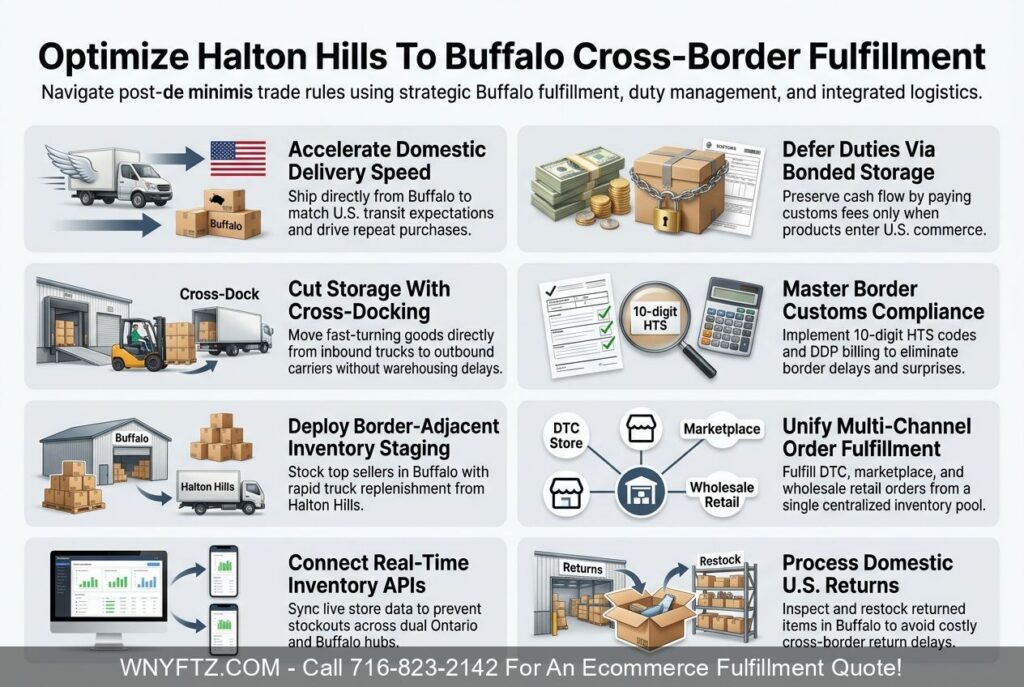
What Is Cross-Border Ecommerce Fulfillment Between Halton Hills and Buffalo, and Why Does This Corridor Work?
Cross-border ecommerce fulfillment between Halton Hills and Buffalo means storing, packing, and shipping your orders across the border. The corridor works because Buffalo sits right at the border, so stock can move into the U.S. quickly.
You have two basic ways to do it, and the difference shapes your costs. Below, you will see both, plus the full list of services a 3PL can handle for you.
What is the difference between cross-border and localized fulfillment?
Cross-border fulfillment means shipping products directly from your home country to customers in another country. For you, that means packing orders in Halton Hills and sending each parcel over the border.
Localized fulfillment means storing and shipping products inside the destination country using local fulfillment centers. For you, that means keeping stock in a Buffalo warehouse and shipping U.S. orders from there.
What common fulfillment problems can a 3PL help you fix?
A 3PL (third-party logistics company) helps you fix the main cross-border drawbacks: longer delivery times, higher shipping rates, complex customs clearance, and unmet customer expectations. Those are the same pains that likely brought you here.
Buffalo fulfillment centers sit just 10 minutes from the Canadian border via the Peace Bridge. A short hop like that helps your stock reach U.S. shelves without a long trip inland.
Which fulfillment and 3PL services are available for Halton Hills sellers?
Cross-border fulfillment service scope for the Halton Hills to Buffalo lane covers the full path of an order. A 3PL can store your inventory, pick and pack each order, build kits and bundles, prepare bulk shipments for retail and wholesale buyers, hand parcels to carriers for final-mile delivery, and manage the cross-border shipping and customs paperwork that gets your stock into the U.S. in the first place. When you call a provider, ask which of these services they offer and which ones they handle directly.
Should You Ship From Halton Hills or Stock Inventory in Buffalo After the $800 Duty-Free Rule Ended?
Shipping from Halton Hills usually makes sense while U.S. orders are low or uncertain, and Buffalo stock is worth pricing once demand is steady. Use 500 to 1,000 U.S. orders a month as a rough screening range, not a hard switch point or a provider minimum.
Here is why the math changed. U.S. Customs and Border Protection (CBP) indefinitely suspended the $800 duty-free exemption for all shipments, so each one now needs an informal or formal entry. Exporters can expect higher shipping costs, new compliance burdens, and greater risks of shipment delays.
How do the two options compare?
The table below puts the two choices side by side, using the numbers you can check in the sources.
| Factor | Ship from Halton Hills (cross-border) | Stock in Buffalo (localized) |
|---|---|---|
| Customs per order | Non-postal orders at or under US$800 face all applicable duties and full customs clearance | Customs handled when stock crosses in bulk, not parcel by parcel; applicable import duties still apply |
| Added cost per order | Duties, processing, and brokerage can add $15 to $30 or more | No per-parcel border charges, but you pay for bulk entry, receiving, storage, and pick-and-pack |
| Delivery and rates | Longer delivery times and higher shipping rates | Orders ship from inside the U.S. using local fulfillment centers |
| Shipping terms | DDU (Delivered Duty Unpaid) is now unviable, so plan for DDP | U.S. customers get domestic-style orders |
| Best fit | Low U.S. volume or testing the market | Roughly 500 to 1,000 U.S. orders a month or more, after a full-cost check |
What does the end of de minimis mean for Halton Hills sellers?
The end of de minimis means low-value U.S. orders from Halton Hills no longer skip duties automatically. The old US$800 duty-free exemption is suspended.
In plain terms, “de minimis” was the small-value cutoff below which goods entered duty-free. Losing it does not mean every parcel owes the same duty. What you owe depends on your product’s tariff code, where it was made, and whether it qualifies under CUSMA.
DDU meant your customer paid duties on delivery, which often led to surprise bills and refused parcels. DDP (Delivered Duty Paid) means you pay the duties up front, so your customer gets no surprise charge. Postal and courier shipments can follow different entry steps, so ask your carrier or broker which rules apply to you.
What monthly order volume should you share with a provider?
Share your average monthly U.S. order count, plus your busiest month. Those two numbers tell a 3PL whether you sit near the 500 to 1,000 order screening range.
Next, compare the same monthly U.S. volume under both models. Count every cost on each side:
- Shipping from Ontario: parcel shipping, applicable duties, brokerage, and returns.
- Stocking in Buffalo: bulk freight to Buffalo, import duties and entry costs, receiving, storage, pick-and-pack, packaging, U.S. postage, returns, and any monthly minimum fees.
For example, say you ship a few hundred U.S. orders a month and each one picks up $15 to $30 in added costs. Multiply those costs by your order count, then ask the 3PL to quote both setups so you compare full totals. Buffalo stock combines your border handling into bulk entries, but it does not erase import duties.
Is a hybrid model the right first step?
A hybrid fulfillment network is the right first step for most growing sellers. A hybrid network means starting with cross-border shipping, then moving to local warehouses and fulfillment centers as demand grows.
You can stock your best sellers in Buffalo first and keep slower items shipping from Ontario. Then you add more SKUs as your U.S. sales climb.
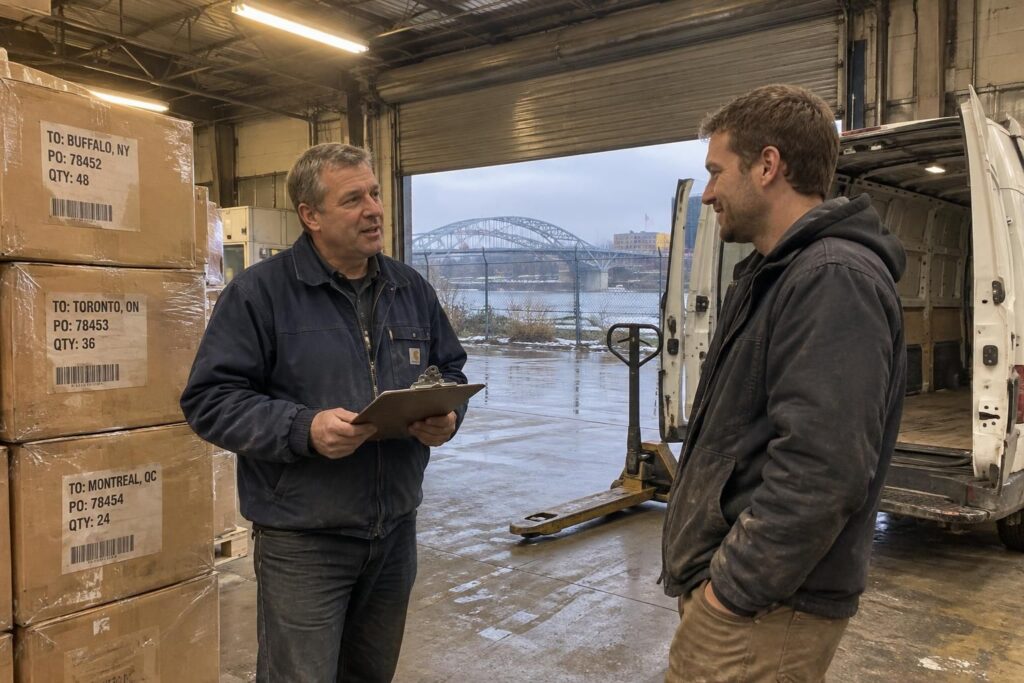
Trend #1: Faster U.S. Delivery Is Becoming the Standard Your Customers Expect
Faster U.S. delivery is best for sellers whose U.S. customers compare you with domestic stores. Cross-border shipping brings longer delivery times and unmet customer expectations.
Faster U.S. delivery starts with where your stock sits. Localized fulfillment means storing and shipping products inside the destination country, so your parcels skip the border on the way to the customer.
A Buffalo warehouse near the I-90 and I-190 highways can get orders onto U.S. carrier routes quickly. Your parcels then travel the same way a local seller’s would.
Faster U.S. delivery also helps your brand earn repeat buyers. When orders arrive on time, customers tend to trust you and order again.
Your Halton Hills business can tap into faster delivery by working with a 3PL near the border. Ask each provider for its daily order cutoff time and which carriers it uses.
Trend #2: Duty Deferral and Bonded Storage Help You Pay Duties Only When Goods Ship
Duty deferral is best for sellers who hold a lot of stock and want to protect cash flow. With duties, processing fees, and brokerage adding $15 to $30 or more per cross-border order, the timing of your duty payments matters.
What are duty deferral and bonded storage?
Duty deferral lets eligible goods sit under an approved customs setup, with applicable duties generally due when the goods enter U.S. commerce. A bonded warehouse is a secure space approved by customs where goods can wait before duties are paid.
Duty deferral is timing relief, not a duty cut. You still pay what you owe, just later, often closer to when you sell. The exact trigger depends on your customs setup, not simply on when a customer order ships.
How does a Foreign Trade Zone fit in?
A Foreign Trade Zone (FTZ) is a special area where goods are treated as outside the normal U.S. customs territory until they are entered for U.S. use. You can read a plain overview of Foreign Trade Zone status from a trade law view.
FTZ storage and bonded storage follow different rules. Limits on storage time, which taxes apply, what work can be done on the goods, and what happens to duties on goods that are re-exported or destroyed all depend on your products and setup. Ask your provider to walk you through how these rules would work for your exact items.
What should you ask your provider about duty deferral?
Duty deferral works best when you go in with clear questions. Before you sign up, recalculate your landed costs with duties and brokerage fees included, then revise your pricing.
- Do you offer bonded or FTZ storage, and for which kinds of goods?
- Can you legally do pick-and-pack, kitting, and partial withdrawals on my goods under your approval?
- Is weekly entry filing available under your program, and how would it affect my Merchandise Processing Fees?
- How do partial withdrawals work when I sell stock over several weeks?
Trend #3: Cross-Docking Keeps Your Products Moving Instead of Sitting on Shelves
Cross-docking is best for seasonal, fast-moving, or time-sensitive products. Cross-docking moves goods straight from inbound trucks to outbound shipments without long-term storage in between.
With cross-docking strategies, a truck from Halton Hills unloads in Buffalo and the goods are sorted onto outbound loads. Your products keep moving instead of piling up on shelves.
Cross-docking can lower storage needs because less stock sits still. Cross-docking also works well for retail replenishment, where full cases head to store distribution centers.
Cross-docking fits the volume picture too. Once you near 500 to 1,000 U.S. orders a month, U.S.-side handling often beats parcel-by-parcel cross-border shipping.
Ask a provider how fast inbound freight is unloaded and sorted. Also ask whether cross-docking and regular storage can be mixed for different SKUs.
Trend #4: Better Customs Prep Is Taking the Stress Out of Border Compliance
Better customs prep is best for every Halton Hills seller shipping to the U.S. right now. Export Development Canada puts it plainly: “Canadian exporters must now treat every low-value shipment as a high-stakes transaction.”
CBP’s change came from rising concern at the border. CBP processed 1.36 billion de minimis shipments in 2024 and cited concerns about undervaluation, misclassification, and illicit goods.
What steps should you take to prepare?
Customs prep comes down to a short set of steps. Work through them in this order.
- Identify affected products. List every SKU you sell to U.S. customers.
- Review your HTS classifications. HTS codes are the tariff codes that tell customs what your product is, and 10-digit codes are now mandatory.
- Validate CUSMA eligibility. CUSMA is the trade deal between Canada, the U.S., and Mexico, and some goods that qualify may get better duty treatment.
- Update your documentation. Make sure invoices, values, and product details match your codes.
- Recalculate landed costs. Include duties and brokerage fees, then revise your pricing models.
- Switch to DDP shipping. Pay duties up front so customers do not get a surprise bill at the door.
What is still changing at the border?
Border rules are still moving, so keep an eye on updates. CBP set Entry Type 13 testing to begin September 22, 2026, for electronic informal processing of mail shipments under $2,500.
Your freight to Buffalo usually crosses at the Peace Bridge. WNYFTZ offers customs compliance assistance and in-house paperwork help, so ask which of these steps the team can handle for you.
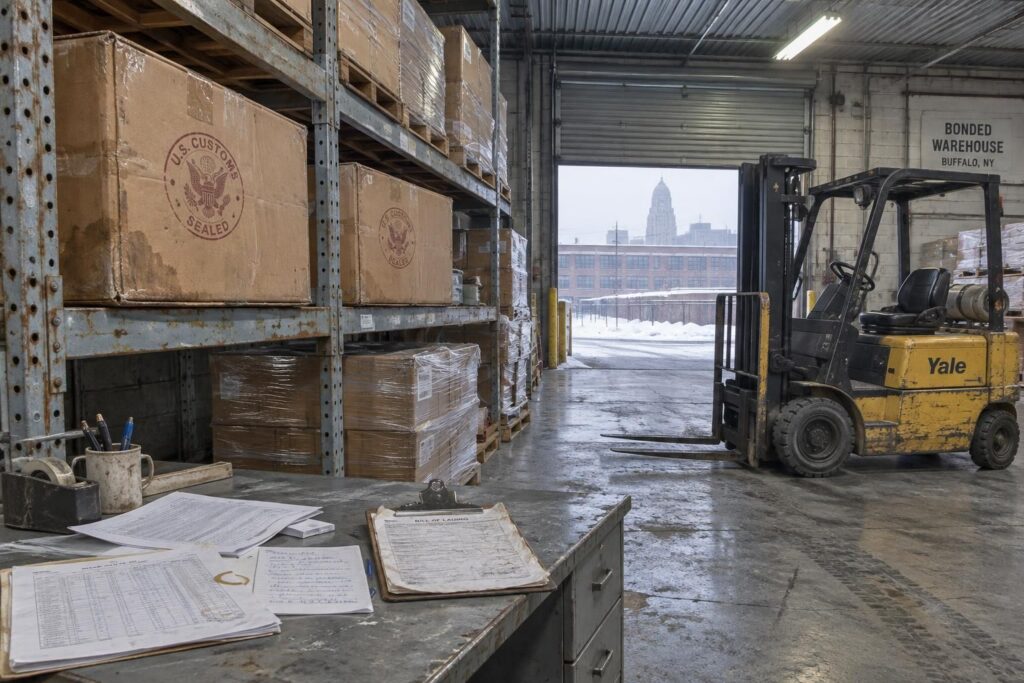
Trend #5: A Border-Adjacent Warehouse Lets You Serve Both Canadian and U.S. Shoppers
A border-adjacent warehouse is best for sellers who want to keep serving Canadian buyers from Ontario while growing in the U.S. Buffalo is just 10 minutes from the Canadian border via the Peace Bridge.
In practice, your Halton Hills location keeps handling Canadian orders, while your Buffalo stock handles U.S. orders from inside the country.
A Buffalo stocking point is easy to refill. Trucks from the west GTA can top up U.S. stock often, so you do not need to tie up cash in a huge U.S. inventory.
Which products should you stock in Buffalo first?
Your steady U.S. best sellers belong in Buffalo first. Slow movers, bulky items, and products you are still testing can keep shipping from Ontario.
Set a reorder point for each Buffalo SKU so the next truck leaves Ontario before stock runs low. Working close to your end customers on both sides also lets you respond quickly when demand shifts.
Trend #6: One 3PL Now Handles Your DTC, Retail and Marketplace Orders Together
One multi-channel 3PL is best for sellers who sell through their own store, marketplaces, and retail buyers at the same time. Managing orders from many channels with separate systems creates duplicate inventory and real headaches.
With one 3PL, your direct-to-consumer, retail, and marketplace orders all pull from the same U.S. stock. WNYFTZ offers integrated ecommerce order support that brings these channels into one system.
Integration with major ecommerce platforms such as Shopify, Amazon, and WooCommerce means your orders flow automatically to the fulfillment center. Your inventory sits in one place instead of being scattered across several warehouses.
Do you need DTC ecommerce or B2B retail and wholesale fulfillment?
You need DTC fulfillment if you ship single orders to shoppers, and B2B fulfillment if you ship cases or pallets to stores and distributors. Many Halton Hills brands need both.
DTC (direct-to-consumer) work focuses on fast pick-and-pack, branded packaging, and parcel shipping. B2B retail and wholesale work focuses on bulk orders, store labels, and meeting each retailer’s shipping rules.
If you sell on marketplaces, ask whether the 3PL can prep stock to each marketplace’s inbound rules. Also ask whether DTC and B2B orders can share one inventory pool.
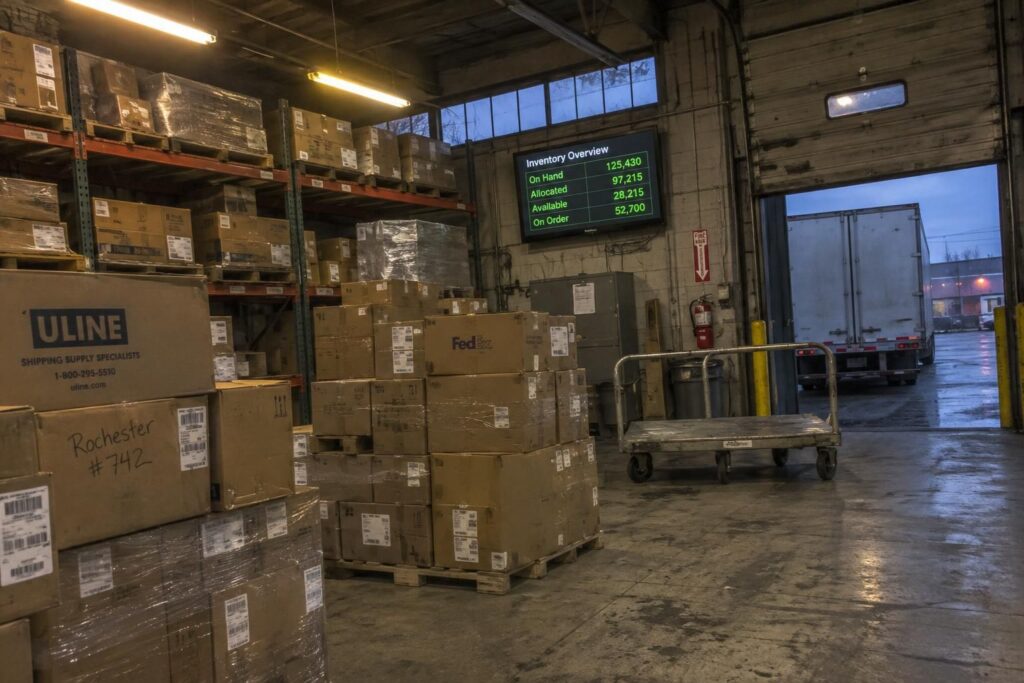
Trend #7: Real-Time Store Connections Show You Exactly What Stock You Have
Real-time store connections are best for sellers who split stock between Halton Hills and Buffalo. Real-time store connections link your online store, marketplace accounts, and warehouse so stock counts update whenever a customer places an order.
An API is simply a software link that lets two systems share data. With an API link in place, your inventory syncs across all sales channels.
Real-time store connections stop you from selling products you do not actually have. Live counts also help prevent stockouts that hurt customer trust.
Advanced warehouse management systems at WNYFTZ support real-time stock tracking for clients. Warehouse and transportation systems can also show shipment tracking, so you know where each order is.
Why does real-time stock data matter on a two-country setup?
Real-time stock data matters because you are running two pools of inventory. You need to know when Buffalo is running low so you can send the next truck from Ontario in time.
Good data also helps you decide what to stock in the U.S. and when to reorder, based on real demand. Ask any provider which platforms it connects to and how often stock counts refresh.
Trend #8: U.S. Returns That Stay in the U.S. Are Becoming a Competitive Advantage
U.S. returns that stay in the U.S. are best for apparel, footwear, and other products with frequent returns. Standard cross-border shipping adds two to three extra days for returns.
When returns go back across the border, you face the same slow delivery, higher rates, and customs hassle as outbound orders. Keeping U.S. returns in a U.S. warehouse avoids that round trip.
With localized fulfillment, a returned item goes to your Buffalo stock, gets checked, and can be resold to the next U.S. buyer. Sellable stock stays close to where it will sell again.
Simple U.S. returns help build loyalty and repeat business. A 3PL that handles both outbound orders and returns lets you work with one partner instead of several.
Ask any provider how returns are inspected, how fast good items go back on the shelf, and how damaged items are handled.
Why Do Halton Hills Brands Choose WNYFTZ for Cross-Border Ecommerce Fulfillment and 3PL Services?
Halton Hills brands choose WNYFTZ because it runs fulfillment in Buffalo, about 10 minutes from the border via the Peace Bridge, with storage, order handling, and customs paperwork help in one place. WNYFTZ supports cross-border shipping between Halton Hills and Buffalo.
What services and benefits should you expect from WNYFTZ?
WNYFTZ offers a range of services that cover the main needs on this lane. Here is what to ask about:
- Warehouse storage in Buffalo near the Peace Bridge
- Pick-and-pack for DTC orders
- Integrated order support for DTC, retail, and marketplace channels
- Cross-docking for fast-moving and seasonal goods
- Customs compliance help and in-house paperwork support
- Real-time stock tracking through warehouse management systems
- Automated updates so you stay informed on your orders
Which setup fits your business?
Matching providers to business needs means asking for proof of each capability, not just a yes on the phone. The services listed above are the ones WNYFTZ describes; confirm anything else, like kitting or special storage, directly on your call.
- DTC brands: check store connections, daily order cutoffs, and parcel pick-and-pack speed.
- B2B retail or wholesale sellers: check case and pallet handling, store labels, and how the team follows each retailer’s routing rules.
- Marketplace sellers: check channel-specific prep and labeling for each marketplace you use.
- Brands with bundles: check how kitting works, including assembly instructions, component tracking, and labor pricing.
- Sellers with special products: check the exact storage, handling, and paperwork your goods need.
Do you need specialized storage, such as healthcare logistics?
You need specialized storage if your products have temperature, handling, or regulatory needs, such as healthcare items. Ask the provider directly whether it supports those goods before you send stock.
Bring a written list of needs to the call. Include the temperature range, lot and expiry tracking, special handling, and any rules your goods must meet.
What reviews are available for Halton Hills fulfillment and 3PL services?
Reviews for fulfillment and 3PL services are best checked on public review sites and through references. Ask WNYFTZ for client references you can call, ideally from sellers who ship from Ontario.
Call 716-823-2142 for a Quote
Call 716-823-2142 to get a custom quote from WNYFTZ for cross-border fulfillment. The team answers questions about cross-border logistics in Erie County, NY, and how to move your products from Halton Hills to Buffalo.
To get an accurate quote fast, have these ready before you call:
- Your monthly U.S. order volume, plus your busiest month
- Your SKU count and product sizes
- Your sales channels, such as Shopify, Amazon, or retail buyers
- Your 10-digit HTS codes
- Your CUSMA eligibility status
- Any special needs, such as kitting, bonded storage, or returns
Whether you need full HALTON HILLS ONT ecommerce fulfillment & 3PL services or a small test with a few SKUs, a clear picture of your volume helps the team suggest the right setup. Bring your current per-order costs too. Then ask for a quote on both setups, shipping from Ontario and stocking in Buffalo, so you can compare full costs side by side.
People also ask:
1. What do HALTON HILLS ONT 3PL services in 2026 offer online sellers?
They store your goods, pick and pack each order, and ship to buyers on both sides of the border. Most providers also manage customs documentation and handle returns, so you can stay focused on growing your sales.
2. How does HALTON HILLS ONT cross border logistics work with Buffalo NY?
Your goods move by truck from Halton Hills to a warehouse in Buffalo, just about two hours away. From there, your orders ship to U.S. buyers at domestic rates, which can cut delivery costs significantly.
3. Why is HALTON HILLS ONT cross border ecommerce fulfillment growing so fast?
More Canadian brands want fast, affordable delivery to American shoppers, and the Halton Hills to Buffalo corridor makes that easy to pull off. According to the U.S. Census Bureau, U.S. retail e-commerce sales topped $1.1 trillion in 2023. That kind of demand makes a Buffalo fulfillment hub a smart move.
4. How can I get started with cross border ecommerce fulfillment?
Call 716-823-2142 to talk with a team that knows the Halton Hills to Buffalo route. They can review your order volume, walk you through your options, and help you set up a plan that fits your business.
