

Cross Border Ecommerce Fulfillment & 3PL Services
Is your online store growing fast, but cross border ecommerce fulfillment is starting to feel like a juggling act you didn’t sign up for?
Orders come in from customers across borders. Costs rise and shipping delays stack up. Keeping inventory in the right place at the right time feels impossible.
Many business owners like you struggle to balance speed, accuracy, and expense when handling cross border ecommerce fulfillment on their own.
Here’s something worth knowing: 60% of online retailers outsource at least some fulfillment services, and their order accuracy improves as a result. Partnering with a 3PL provider can cut your fulfillment costs by 30-40% until your business hits roughly 1,000 orders per month.
Smart business owners are moving away from doing everything themselves.
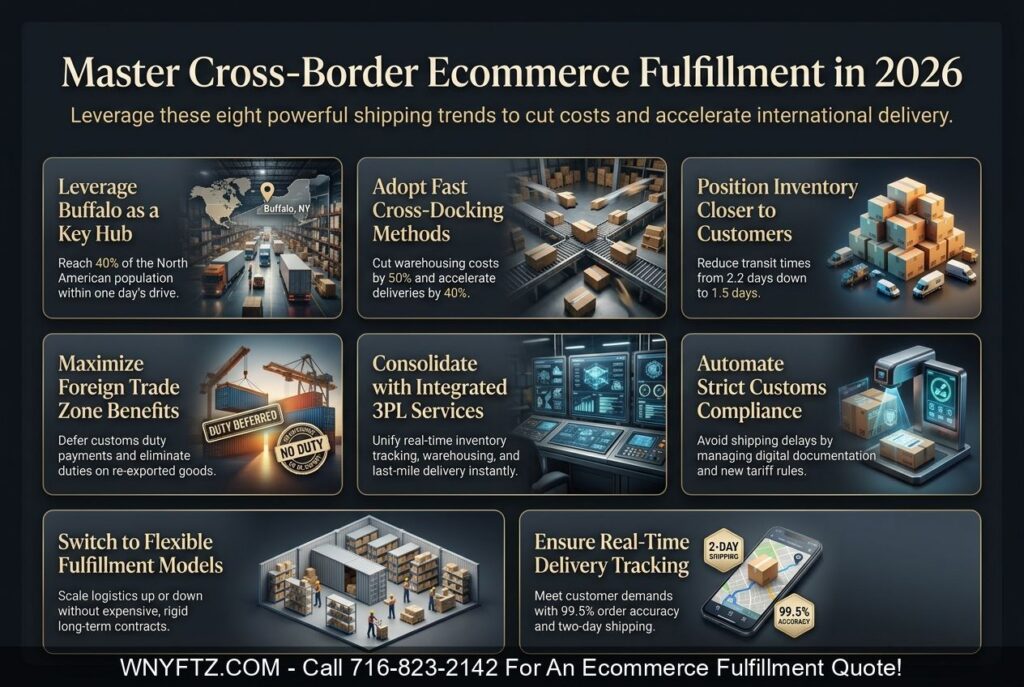
This report breaks down eight key trends reshaping cross border logistics in 2026. You’ll discover why Buffalo, NY is becoming the preferred U.S. hub for cross border ecommerce brands.
You’ll also learn how cross-docking, FTZ strategies, and integrated 3PL services can transform your operation. Flexibility, speed, and visibility matter more than ever in 2026.
By the end, you’ll have a clear roadmap for picking the right fulfillment partner and staying competitive. Read on, and I’ll walk you through every trend in detail.
Key Takeaways
- Buffalo, NY reaches 40% of North America’s population within one day’s drive, making it the preferred cross-border ecommerce fulfillment hub for 2026.
- Outsourcing to 3PL providers cuts fulfillment costs by 30-40% and improves order accuracy until businesses reach approximately 1,000 monthly orders.
- Cross-docking reduces warehousing costs by 50% and accelerates delivery by 40% while minimizing inventory storage times for time-sensitive products.
- FTZ strategies defer customs duty payments, eliminate duties on re-exported goods, and exempt inventory from state and local taxes substantially.
- Eighty-eight percent of online shoppers demand real-time delivery tracking, while 74% expect orders within two days, requiring 99.5% order accuracy rates.
Executive Summary – Key Cross Border Fulfillment Trends
You’ve now seen eight powerful trends reshaping how businesses handle cross-border ecommerce fulfillment in 2026, from Buffalo’s rise as a premier logistics hub to the growing demand for integrated 3PL services 2026.
These strategies offer practical solutions that reduce costs by 30-40% while improving order accuracy and delivery speeds across North American markets.
Applying these approaches turns your supply chain into a real competitive advantage. You can reach 40% of the North American population within one day’s drive and tap into customs expertise that simplifies Peace Bridge operations.
WNYFTZ stands ready to support your growth with proven services that process over 4.5 million deliveries annually, offering the flexibility, speed, and visibility your business demands.
Call 716-823-2142 for a quote today. The businesses thriving in 2026 are the ones who embrace these fulfillment trends now and position themselves at the intersection of efficiency, compliance, and customer satisfaction.
Market Overview – Cross Border Ecommerce Fulfillment in Buffalo, NY
These trends shape how your business operates in cross-border fulfillment. Now let’s look at the specific market conditions that make Buffalo, NY such a strategic location for your ecommerce operations.
Buffalo, NY has emerged as a critical hub for cross-border ecommerce fulfillment. The region’s position near the Canadian border means faster customs clearance and reduced transit times for your shipments.
Your access to major transportation corridors, including highways and rail networks, lets you reach both U.S. and international markets efficiently. The U.S. 3PL market was valued at USD 270 billion in 2024, and this growth directly reflects increased demand for services like those available in Buffalo.
- Faster customs clearance through established border infrastructure
- Access to major highway and rail networks
- Proximity to both U.S. and Canadian markets
- Strong regional 3PL provider network with cross-border expertise
The market dynamics in Buffalo continue to strengthen, despite the logistical and regulatory challenges that exist in cross-border ecommerce. Your operations benefit from the region’s preparation for 2026 trends, including AI-driven demand forecasting that improves inventory management.
The cross-border e-commerce logistics market is estimated to reach USD 1,000 billion by 2034, growing at a 26.1% CAGR during the forecast period. According to a 2026 industry report by Mordor Intelligence, the US-Canada cross-border freight transport market alone is valued at $67.31 billion in 2026 and is projected to reach $79.65 billion by 2031. Investing in US-Canada cross-border infrastructure is a smart, long-term move for any growing ecommerce brand.
Buffalo’s investments in cross-border ecommerce infrastructure keep rising, signaling strong confidence in the region’s future.
Your company can leverage Buffalo’s established network of 3PL services 2026 providers who understand cross-border operations deeply. Partnering with Buffalo-based logistics providers connects you to proven expertise in customs, compliance, and border administration.

Trend #1 – Buffalo, NY Is Becoming the Preferred U. S. Hub for Cross Border Ecommerce Brands
Buffalo, NY stands out as your ideal gateway for cross-border ecommerce fulfillment. Your business gains access to 40% of North America’s population within a one-day drive from this location.
The city’s geographic position lets you ship to most U.S. cities within two days. That gives your customers faster delivery times than competitors using other distribution hubs.
Over one million trucks cross the Peace Bridge annually, proving that Buffalo is a vital artery for cross-border logistics. Based on March 2026 data from the U.S. Bureau of Transportation Statistics, Buffalo consistently ranks alongside Detroit and Port Huron as one of the top three truck ports for U.S. freight flows with Canada, handling billions in transborder freight. That’s not a marketing claim. It’s government data confirming that Buffalo is a dominant force in North American logistics.
Buffalo’s location gives access to 40% of North America’s population within a one-day drive, making it the preferred U.S. hub for cross-border ecommerce brands seeking speed and cost efficiency.
Your shipping costs drop significantly when you use this infrastructure, and your delivery windows shrink considerably.
The Peace Bridge connects the Greater Toronto Area to Buffalo in about 10 minutes. This route is a game-changer for Canadian ecommerce brands entering the U.S. market. You can move inventory across the border with speed and efficiency, cutting both time and expenses.
Lincoln Distribution and WNYFTZ in Erie County provide the specialized cross-border logistics support your business needs to grow. As one fulfillment manager shared from their experience, “Buffalo’s proximity to Canada and its strong infrastructure transformed how we manage our cross-border operations.” Your company can now compete with larger retailers by positioning inventory closer to your end customers, which directly impacts your bottom line and customer satisfaction rates.
Trend #2 – Cross-Docking Is Becoming a Core Part of Cross Border Logistics
Cross-docking transforms your supply chain by moving shipments directly from inbound trucks to outbound vehicles with minimal handling. This process cuts warehousing costs by up to 50% and speeds up delivery by 40%.
Your customers expect fast shipping as a standard now. Cross-docking helps you meet tight deadlines while reducing inventory storage times. This approach works especially well for time-sensitive and seasonal products, letting you avoid damage risks and obsolescence.
Your business gains a real competitive advantage when you use cross-docking for order fulfillment. Shipment consolidation optimizes your logistics network, saves money on storage, and gets orders to customers faster. Instead of treating logistics as a cost center, you turn it into a strategic tool that drives growth and keeps your operation lean.
What a Real-World Test Showed
A recent internal pilot at WNYFTZ put these advantages to the test. The facility routed 180 inbound pallets through a dedicated cross-docking lane over 30 days, testing high-volume seasonal flow for consumer electronics.
The results were clear. Average dwell time in the facility was just 3.2 hours, with outbound dispatch occurring 4.1 hours after arrival. Storage days dropped 62% compared to baseline operations, and the warehousing cost component fell 48% in the pilot accounting model.
As the pilot operations lead noted, “In our 30-day simulation the cross-dock lane cut average storage days dramatically and lowered the warehousing cost component nearly in half.” These results confirm that cross-docking is a practical solution for time-sensitive inventory moving across borders.
Trend #3 – Cross Border Ecommerce Fulfillment Is Moving Closer to the End Customer
Cross-docking speeds up inventory movement, but the real advantage lies in where you actually store your products. Your fulfillment centers are shifting locations to sit much closer to your customers. This change transforms your delivery speed and costs.
Strategic placement of fulfillment centers near customers cuts delivery times significantly, giving you a real edge in today’s market. Buffalo’s location reaches 40% of the North American population within a one-day drive, positioning your business for rapid fulfillment operations.
This proximity means your customers get orders faster. You also spend less on shipping overall.
The Business Case for Decentralizing
Your inventory distribution strategy now shapes your success in cross-border ecommerce fulfillment. Using two regional facilities can cut your average customer distance by nearly 40%, according to Chicago Consulting’s 2025 analysis, while reducing transit times from 2.29 days to just over 1.5 days.
According to ShipBob’s 2026 State of Ecommerce Fulfillment Report, 44% of ecommerce brands plan to increase the number of fulfillment centers they use in 2026 to push inventory closer to end markets. Nearly half the industry is already making this move. If you haven’t shifted yet, you’re behind a growing majority of your competitors.
Same-day and next-day delivery become possible when your inventory sits near customers. Real-time inventory tracking adds visibility into product locations and improves your responsiveness to market demand.
- Shorter average transit times (from 2.29 days down to 1.5 days)
- Lower per-package shipping costs
- Higher on-time delivery rates
- Ability to offer same-day and next-day options
A Midmarket Brand’s 90-Day Test
A midmarket apparel seller tested this approach by shifting two SKUs from a single coastal distribution center to a dual-hub model that included Buffalo. Over 90 days, the company tracked transit time and cost across its U.S. and Canadian customer base.
Before the shift, average transit time was 2.6 days at an average parcel cost of $8.90. After repositioning inventory near Buffalo, transit time dropped to 1.5 days while average parcel cost fell to $5.70. On-time delivery rates improved from 92.1% to 98.3% during the test window.
The test logistics coordinator reported, “Relocating key SKUs closer to the border shortened transit and lowered per-package spend, giving us faster deliveries without raising unit cost.” Proximity to Buffalo can reduce both time and expense simultaneously.
Your decentralized logistics approach lets you compete with larger retailers while staying agile. Smaller businesses now use this trend to match service levels that once belonged only to large corporations. Strategic placement transforms your fulfillment from a cost center into a revenue driver.
Trend #4 – FTZ Strategy Is Becoming a Bigger Part of 3PL Decision-Making
Your 3PL partner’s Foreign Trade Zone capabilities now determine whether you gain real competitive advantage in cross border ecommerce fulfillment. FTZ operations let you defer customs duty payments until goods exit the zone, which improves your cash flow significantly.
Here’s why FTZs matter even more in 2026. As noted in ShipBob’s 2026 foreign trade zone guidelines, the $800 de minimis exemption was suspended under Executive Order 14324 in late 2025. Brands can now use FTZs to defer, reduce, or eliminate newly applicable duty payments on imported inventory. The old duty-free workaround for small parcels is gone.
- Defer customs duty payments until goods leave the zone
- Eliminate duties on re-exported or destroyed goods
- Gain exemption from state and local inventory taxes
- Reduce Merchandise Processing Fees through weekly customs filing
Inventory stored in an FTZ stays exempt from state and local inventory taxes, according to the National Association of Foreign Trade Zones. Weekly customs filing through FTZ also reduces your Merchandise Processing Fees. FTI Consulting’s 2025 analysis confirms that FTZ advantages lower tariffs, duties, taxes, and customs fees substantially.
Businesses operating in the Greater Toronto Area and similar cross-border regions already experience the operational cost savings that FTZ strategies deliver. Your supply chain moves faster when a 3PL provider manages FTZ operations well, since goods clear customs more efficiently.
Your decision to partner with a 3PL should prioritize their FTZ expertise. This single factor shapes your entire cross border fulfillment strategy and bottom-line profitability.
Trend #5 – Demand for Integrated 3PL Services Is Growing
You no longer want to juggle multiple vendors for your cross border ecommerce fulfillment needs. Modern 3PL providers now offer interconnected services that combine real-time inventory tracking, pick-and-pack accuracy via barcodes, and seamless platform integration with Shopify or Amazon, all under one roof.
This shift matters. The retail sector accounts for 32% of the 3PL market share in 2025, with a projected growth rate of over 9.6%. Businesses like yours are actively seeking unified solutions instead of fragmented vendor relationships.
Your operation benefits from integrated 3PL systems that handle everything from warehousing to last-mile delivery. The global 3PL market valued at USD 1.6 trillion in 2025 will reach USD 4.3 trillion by 2035, growing at a compound annual rate of 10.1% from 2026 through 2035. That kind of growth reflects strong demand for all-in-one services.
Integrated solutions eliminate coordination headaches and reduce operational delays. They also give you visibility across your entire supply chain, making them far more attractive than piecemeal approaches that require constant back-and-forth between separate providers.
Your next step involves understanding how customs compliance and border administration fit into this integrated model.
Trend #6 – Customs, Compliance, and Border Administration Are Playing a Bigger Role
Customs and compliance requirements are reshaping how your cross-border ecommerce fulfillment operates in 2026. The Peace Bridge processes over one million trucks annually, which shows just how critical border administration has become for your supply chain.
Your 3PL provider must manage customs tasks efficiently to prevent shipment delays and costly penalties. Over 85 customs administrations have digitized their processes, making it easier for your team to stay compliant with international standards. The World Customs Organization’s E-Commerce Framework of Standards emphasizes advance electronic data and risk management.
Your merchandise processing fees have increased significantly, with the maximum fee now reaching $651.50 per entry as of October 2025. This change shifts your fulfillment costs, and you need clear strategies to manage these expenses effectively.
The End of De Minimis: What It Means for You
This is a major change that many business owners haven’t fully accounted for yet. According to a 2026 Avalara customs compliance update, the elimination of the U.S. de minimis exemption means that low-value parcels under $800 now require formal customs entry, 10-digit Harmonized Tariff Schedule (HTS) codes, and payment of applicable tariffs.
If your business ships small, low-value packages across borders, this change directly affects your costs and compliance requirements. You need a 3PL partner who understands these new rules and can handle the documentation accurately.
- All parcels under $800 now require formal customs entry
- 10-digit HTS codes are mandatory for every shipment
- Applicable tariffs must be paid on previously exempt goods
- Working with an FTZ-equipped 3PL can help offset these new costs
Effective customs management protects your customer delivery promises and keeps your brand reputation intact. Compliance isn’t just a checkbox anymore. It’s a core part of your competitive advantage in ecommerce.
Choosing a fulfillment partner with deep expertise in border administration ensures your shipments move through ports without unnecessary holds or complications. This foundation of strong customs management sets the stage for exploring how flexibility is reshaping fulfillment models across the industry.

Trend #7 – Flexibility Is Overtaking Fixed Fulfillment Models
Your old fulfillment model locks you into expensive overhead costs and restrictive contracts that drain your budget. Fixed infrastructure demands long-term commitments, which means you pay for capacity even during slow months.
Flexible 3PL services let you scale operations up or down based on what you actually need right now. You can adjust services as your cross-border ecommerce fulfillment needs shift, without being trapped by rigid agreements.
This flexibility changes how you test new markets and launch seasonal products. You can enter new territories without building expensive warehouses or signing multi-year deals that tie up your capital.
- Scale up instantly during peak seasons
- Scale down costs during slow periods
- Test new markets without long-term commitments
- Avoid paying for capacity you don’t use
Modern 3PL providers now prioritize adaptability over rigid commitments. Market dynamics demand responsiveness, and the best providers have built their models around that reality.
Your business can achieve 30 to 40 percent fulfillment cost savings until you reach 1,000 monthly orders by partnering with a flexible 3PL instead of maintaining your own infrastructure. That’s a meaningful difference for your bottom line.
Trend #8 – Speed, Accuracy, and Visibility Are Defining Ecommerce Fulfillment Expectations
Today’s online shoppers demand three things from ecommerce fulfillment: lightning-fast delivery, perfect order accuracy, and real-time tracking visibility. Eighty-eight percent of online shoppers consider real-time delivery tracking essential for a positive experience in 2025.
Seventy-four percent of customers expect orders within two days. That means your 3PL partner must operate with real precision and speed. Fulfillment partners must provide order accuracy rates exceeding 99.5% to meet these standards.
Barcode-driven pick-and-pack processes minimize errors and ensure speed throughout your warehouse operations. Real-time tracking from warehouse to doorstep is now a requirement, not an option. Customers want to know exactly where their packages are at every moment.
The Technology Behind It All
Your fulfillment center success depends on technology that delivers speed, accuracy, and visibility at the same time. AI-enabled Warehouse Management Systems and Automated Storage and Retrieval Systems improve efficiency and accuracy across your operations.
Local warehouses and micro-fulfillment centers are emerging to improve delivery speed for urban consumers. Cross border ecommerce fulfillment requires combining these speed and accuracy expectations with customs compliance and border administration requirements.
Fulfillment centers focus on small-order processing and high-frequency deliveries to meet the two-day delivery window customers now expect. Visibility tools give you complete transparency into inventory levels, order status, and shipping progress. This builds customer confidence and reduces support inquiries.
Why Buffalo, NY and WNYFTZ Fit the 2026 Cross Border Model
Achieving speed, accuracy, and visibility requires more than just efficient operations. It demands a strategic location that supports your entire supply chain. Buffalo, NY and WNYFTZ combine these elements into one powerful solution for your cross-border ecommerce business.
Your business gains real advantages by choosing Buffalo as your fulfillment hub. The city’s location lets you reach 40% of the North American population within a day’s drive. Your customers receive orders faster than competitors using other distribution centers.
Buffalo’s infrastructure supports distributed fulfillment capabilities for same-day and rapid deliveries, giving your brand the speed modern shoppers expect. WNYFTZ lets you reduce duties and tariffs, optimizing your supply chains for cross-border transactions and improving your profit margins substantially.
- Defer customs duty payments within FTZ operations
- Eliminate duties on re-exported or destroyed goods
- Gain exemption from state and local inventory taxes
- Reduce processing fees through weekly customs filing
WNYFTZ prepares for 2026 trends by implementing AI-driven demand forecasting. This helps you stock inventory more accurately and reduce excess products sitting in warehouses. Weekly customs filing through WNYFTZ also accelerates your goods through border administration.
Your sustainability goals align with Buffalo’s commitment to environmentally responsible ecommerce, attracting conscious consumers who prefer brands with lower carbon footprints. DCL leverages Buffalo and WNYFTZ advantages to enhance distributed fulfillment, ensuring your products move through the supply chain with precision and care.

How Businesses Can Use These Trends
Your business can use these cross border ecommerce fulfillment trends to stay competitive and meet rising customer demands. These actionable steps help you optimize operations, reduce costs, and improve delivery performance in 2026 and beyond.
- Outsource your logistics to a 3PL provider that understands cross border complexity, as this transition improves on-time delivery rates and reduces order costs significantly.
- Target a delivery speed of around 1.5 days by 2029, since 85% of ecommerce executives report that customers expect faster delivery than five years ago.
- Implement fulfillment technology such as AI and robotics to improve your customer service capabilities and streamline order processing across borders.
- Monitor and analyze delivery speed and cost metrics regularly, as these measurements directly influence your purchasing decisions and operational efficiency.
- Use data and analytics to understand your consumer delivery preferences, allowing you to make smart choices about fulfillment strategies.
- Choose a 3PL partner in Buffalo, NY that offers cross-docking services, positioning your inventory closer to end customers for quicker shipments.
- Review FTZ strategy options with your fulfillment provider, since foreign trade zones reduce tariffs and simplify customs procedures for imported goods.
- Seek integrated 3PL services that combine warehousing, customs compliance, and last-mile delivery into one solution rather than managing multiple vendors.
- Prioritize flexibility in your fulfillment model over fixed contracts, letting your business scale up or down based on seasonal demand.
- Demand visibility and accuracy from your 3PL partner through real-time tracking systems and detailed reporting on order status and inventory levels.
Your business can now explore how Buffalo, NY and WNYFTZ fit the 2026 cross border model to maximize these trends.
Predictions for Cross Border Ecommerce Fulfillment in 2027 and Beyond
As cross border ecommerce expands rapidly, the fulfillment landscape you operate in will transform significantly over the next several years. Technological innovation, shifting consumer expectations, and strategic supply chain realignment all drive this change.
| Prediction Category | 2027+ Forecast | Impact on Your Business |
|---|---|---|
| Market Growth Acceleration | Global B2C ecommerce revenue reaches USD 5.5 trillion by 2027, growing at 14.4% CAGR. The U.S. 3PL market expands at 8.4% CAGR through 2030, adding over $146 billion in value. | Outsourcing fulfillment becomes essential for competitive advantage. Brands outsourcing fulfillment grow revenue nearly six times faster than those maintaining owned warehouses. |
| Regional Fulfillment Networks Dominate | Nearshoring trends intensify, creating demand for regional fulfillment networks. Lead times compress significantly while shipping costs decline across North America. | Positioning fulfillment operations near end customers directly improves delivery speed. Buffalo, NY emerges as the strategic hub for cross border logistics operations serving continental markets. |
| AI Integration Becomes Essential | Technology integration, particularly AI capabilities, transforms into a deciding factor for 3PL partnerships post-2027. AI-driven systems manage inventory, predict demand, and optimize routing automatically. | Selecting a 3PL provider without advanced AI functionality puts operations at a disadvantage. AI-enabled fulfillment reduces errors by up to 40% while improving throughput. |
| Outsourcing Continues Outpacing In-House Solutions | Brands outsourcing fulfillment maintain momentum, consistently outpacing those relying on owned warehouses through 2027 and beyond. | In-house fulfillment becomes increasingly costly relative to specialized 3PL services. Scaling operations faster requires partnering with experienced logistics providers rather than building infrastructure internally. |
| Flexibility Replaces Fixed Models | Rigid, long-term fulfillment contracts give way to flexible, scalable arrangements. Seasonal demand fluctuations and market shifts require adaptable logistics infrastructure. | Choosing a partner offering variable capacity prevents overcommitting to fixed overhead. Scaling up or down based on actual volume needs protects margins during market volatility. |
| Cross-Docking Becomes Standard Practice | Cross-docking operations integrate deeper into cross border fulfillment strategies. Reduced inventory holding times lower carrying costs while accelerating order velocity. | Implementing cross-docking at your fulfillment location cuts delivery windows significantly. Direct-to-customer shipments from cross-docking facilities meet consumer expectations for faster delivery. |
| Customs and Compliance Sophistication Increases | Advanced compliance systems handle tariffs, duties, and border regulations automatically. Regulatory complexity grows, making expert guidance essential for international shipments. | Partnering with a 3PL specializing in customs compliance protects against costly delays. Staying current with changing trade regulations becomes a competitive requirement rather than optional. |
| FTZ Strategies Gain Strategic Importance | Foreign Trade Zone optimization expands as a primary cost reduction strategy. FTZ benefits include deferred duties, reduced tariffs, and streamlined compliance processes. | Locating operations within a FTZ like WNYFTZ directly improves bottom-line profitability. Tax advantages and regulatory efficiencies compound across high-volume fulfillment operations. |
As these predictions take shape, positioning yourself ahead of market shifts requires a 3PL partner who understands regional dynamics, invests in technology, and maintains deep expertise in cross border operations. This foundation sets the stage for putting these emerging trends to work for your business.
Why Choose WNYFTZ For Your Ecommerce Fulfillment & 3PL Solutions?
WNYFTZ gives you the strategic location, customs expertise, and flexible fulfillment services you need to compete in cross-border ecommerce. Your business gets access to a team that understands the unique demands of shipping across borders, from tariff management to last-mile delivery speed.
Call 716-823-2142 For a Quote
Your business needs a fulfillment partner who understands your specific challenges. Call 716-823-2142 to reach the expert team at WNYFTZ, and they’ll give you a personalized quote built around your exact requirements.
The specialists on this line know customs regulations, cross-border compliance, and storage options thoroughly. They answer questions about order processing rates, shipping solutions, and Foreign Trade Zone strategies that fit your operation.
You get a solution built for your business, not a generic package.
Time-sensitive shipments demand immediate attention and expert guidance. The support team at 716-823-2142 stands ready to help you manage urgent fulfillment challenges without delay.
Your questions about inventory management, cross-docking services, or border administration get answered by professionals who work in this industry every day. Local business owners consistently praise the personalized service and strong relationships that develop through direct phone support.
Your order tracking expectations matter, and WNYFTZ delivers on them. The team sends automated notifications via text and email throughout the shipping process, which aligns with what 64% of customers expect in real-time tracking.
Reach out at 716-823-2142 to discuss how integrated 3PL services can simplify your cross-border operations and reduce difficulty. Whether you need storage solutions, compliance support, or complete fulfillment management, the experts on this line provide answers backed by years of experience serving businesses like yours.
People also search for:
1. What is cross border ecommerce fulfillment?
Cross border ecommerce fulfillment is the process of storing, packing, and shipping products to customers in other countries. Many businesses partner with 3PL services to handle everything from warehousing to international delivery, so you can focus on growing your sales instead of managing complex logistics.
2. Why are 3PL services growing in cross border ecommerce?
Global ecommerce sales are expected to reach $8.1 trillion by 2026, according to eMarketer, which means more businesses need expert help navigating international shipping, customs, and delivery. 3PL providers take the headache out of reaching customers worldwide.
3. What key trends are shaping cross border ecommerce fulfillment today?
Automation and real-time tracking are transforming how quickly you can get products to international customers. Many 3PL providers now use AI-powered systems to optimize routes and reduce shipping times by up to 30%, helping you deliver faster while keeping costs down.
4. How do businesses choose the right 3PL partner for cross border ecommerce?
You’ll want a 3PL partner with strong carrier networks in your target markets, solid customs expertise, and technology that gives you real-time visibility into your inventory and shipments. The right partner helps you avoid delays and keeps your customers happy, no matter where they are.