

Cross Border Ecommerce Fulfillment Between NORTH YORK ONT And Buffalo NY
Cross Border Ecommerce Fulfillment Between NORTH YORK ONT And Buffalo NY – The Top 8 Trends – Call 716-823-2142
Have you ever watched an order sit at the border while your customer keeps emailing to ask where it is? If you sell online from Canada into the US, you probably know that feeling. Smart NORTH YORK ONT ecommerce fulfillment can make that problem go away.
Selling across the Canada-US border brings real headaches. You deal with customs delays, higher shipping costs, and complex inventory management that slows your growth.
Lots of business owners struggle to find a setup that works well on both sides of the border.
Here’s what I’ve learned matters most: location. Buffalo is often described as reaching about 40% of the North American population within a one-day drive. That kind of reach changes how your cross-border business runs and how much money you keep.
The good news is that the right 3PL partner can handle the heavy lifting for you. A 3PL (third-party logistics provider) is a company that stores, packs, and ships your orders.
Below, I’ll walk you through eight trends that help brands cut costs, ship faster, and keep customs simple. Grab a coffee, and let’s go through them together.
Key Takeaways
- Buffalo fulfillment centers reach a huge share of North America’s population within a one-day drive, which shortens delivery times for your US customers.
- Bonded warehousing and duty deferral cut customs costs and protect your cash flow, which matters even more now that US de minimis no longer applies to Canadian shipments.
- Cross-docking cuts warehousing costs and speeds up delivery by moving products straight from inbound to outbound trucks.
- Real-time API integration and inventory visibility systems prevent stockouts and overstocking while giving customers the tracking they expect.
- Omnichannel fulfillment puts direct-to-consumer, retail, and marketplace orders under one 3PL provider, so you skip duplicate warehousing.
Why the NORTH YORK-to-BUFFALO Corridor Is Ideal for Cross Border Ecommerce Fulfillment
Location is the biggest advantage you get here. The Peace Bridge links your North York business straight to Buffalo, and over one million trucks cross it each year. That traffic makes this route the backbone of cross border ecommerce fulfillment between Ontario and the US.
Estimates of Buffalo’s reach vary. One Buffalo 3PL directory on Fulfill.com says the region reaches 55% of the US population and 65% of Canadian consumers. Either way, the message is the same: your inventory sits close to a huge number of buyers.
Here’s what that location does for your NORTH YORK ONT cross border logistics:
- Faster delivery: Buffalo fulfillment centers deliver to most US cities within two days.
- Lower costs: Cross-docking in Buffalo trims warehousing spend and handling time.
- Cheaper outsourcing: Using a Buffalo 3PL can lower expenses by an estimated 30-40% for businesses shipping up to 1,000 orders per month.
- Quick border access: WNYFTZ sits just 10 minutes from the Peace Bridge.
Faster delivery leads to happier customers and more repeat orders. Put these perks together, and the North York-to-Buffalo corridor becomes a smart base for growing into the American market.
Trend #1 – Faster Same-Day and Next-Day Delivery Into the US Market
Your customers want speed. According to Capital One Shopping’s 2025 eCommerce Delivery Statistics, 74% of online shoppers expect delivery within two days.
That expectation should shape your NORTH YORK ONT cross border ecommerce fulfillment plan. When your stock sits near Buffalo, it can reach big US markets fast. Major highways like I-90 and I-190 keep shipping quick and affordable across the region.
Customers ask for same-day and next-day delivery more often when inventory sits close to them.
Speed in delivery directly correlates with customer satisfaction and repeat purchases. – Capital One Shopping, 2025
Why Two Facilities Beat One
Adding a second regional warehouse makes a big difference. According to Chicago Consulting’s 2025 analysis, going from one warehouse to two cuts your distance to customers by nearly 40%. Average transit time drops from 2.29 days to just over 1.5 days.
Faster delivery builds loyalty and repeat sales. Your NORTH YORK ONT 3PL services partner can help you set up this two-facility approach.
An Illustrative Example
Here’s an illustrative scenario. Say a small electronics seller in North York moves 60% of its fast-moving SKUs (individual products) to a Buffalo hub. Here’s what the results could look like after 90 days:
| Metric | Before | After 90 Days |
|---|---|---|
| Average transit time to top 10 US metros | 2.4 days | 1.2 days |
| On-time delivery rate | 84% | 96% |
| Refund requests for late delivery | Baseline | Down 62% |
In that scenario, the brand could move money out of customer service fixes and put it into finding new customers. That’s a smart trade.
Spreading your fulfillment out lets smaller businesses like yours compete with big retailers. You get speed and still keep control. Offering same-day and next-day delivery shows shoppers your brand is fast and reliable.
Trend #2 – Lower Customs Costs Through Bonded Warehousing and Duty Deferral
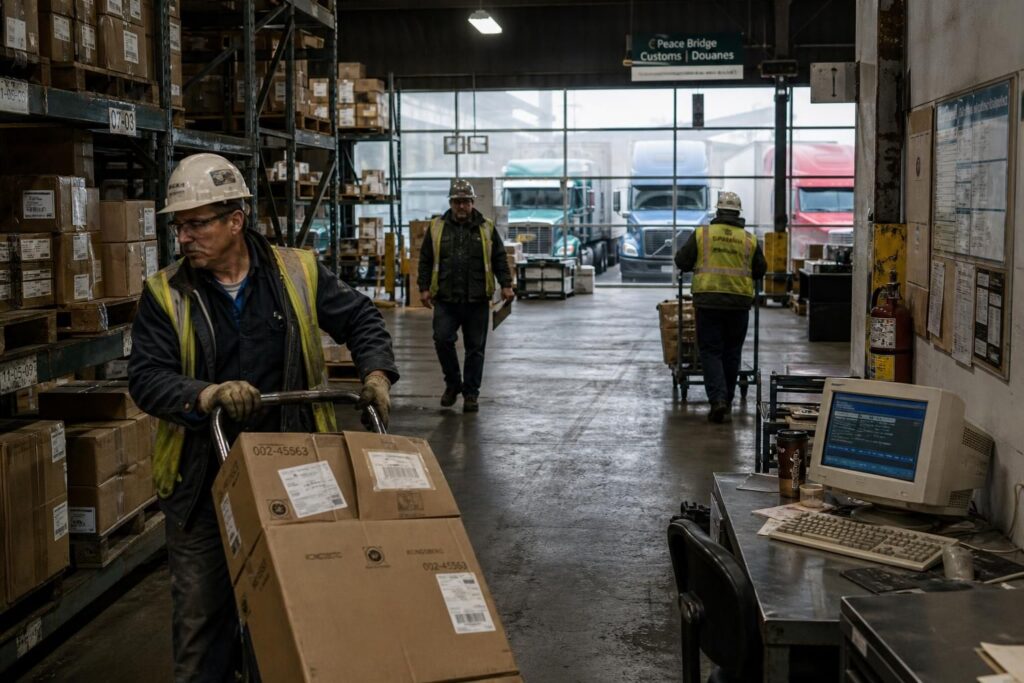
You can cut customs costs a lot with bonded warehousing and duty deferral. A bonded warehouse lets you store goods without paying duties until you release them for sale. That keeps more cash in your pocket.
Duty deferral pushes back your customs payments. This gives you more breathing room as you manage stock across the North York to Buffalo corridor. A 2025 study by FTI Consulting found that FTZ tax breaks lower tariffs, duties, taxes, and customs fees for businesses like yours.
Foreign Trade Zone status in Buffalo lets you hold off on customs duties until goods enter US commerce. An FTZ is a special area where goods count as outside US customs territory until they’re released.
Why This Matters More Than Ever: The End of De Minimis
Here’s the big change many sellers missed. According to Export Development Canada, the Canadian Federation of Independent Business, and U.S. CBP’s e-commerce FAQs, US duty-free de minimis treatment has been suspended for Canadian shipments since August 29, 2025. De minimis was the rule that let parcels under $800 enter the US duty-free.
In June 2026, the suspension moved from an executive order into the customs regulations. Now commercial shipments need a customs entry and any duties owed, no matter their value, unless the goods qualify under CUSMA (the Canada-US-Mexico trade agreement).
| Shipping Method | Can Use CUSMA Exemption? | What It Means for You |
|---|---|---|
| Commercial couriers (UPS, FedEx, DHL) | Yes | CUSMA-eligible goods can still skip duties |
| Postal parcels | No | Duties apply even when goods are CUSMA-eligible |
| Bulk import into a Buffalo bonded or FTZ warehouse | Yes, with documented origin | One entry replaces hundreds of per-parcel filings |
So you can’t just mail small parcels duty-free anymore. Bulk shipping into a Buffalo warehouse, with CUSMA origin on file, is now the simpler path.
More Ways an FTZ Saves You Money
- No state and local inventory taxes on goods stored in the FTZ.
- Weekly customs entries instead of one filing per shipment, which caps your Merchandise Processing Fees.
- No duties on goods that get re-exported or destroyed.
These perks make the North York area a great base for cutting costs without giving up speed or compliance.
Trend #3 – Reduced Fulfillment Costs With Cross-Docking Infrastructure
Cross-docking can shrink your warehousing bill fast. Products move straight from inbound shipments to outbound trucks without sitting in storage. You skip extra handling, and goods spend less time on shelves.
A 2025 supply chain efficiency guide by FarEye found that cross-docking can cut warehousing costs by up to 50% and improve delivery speeds by 40%. Shipment consolidation in Buffalo saves an average of 18% on warehousing costs and improves space use by 20%.
This works best for time-sensitive and seasonal products that need to move quickly.
Illustrative Cost Example: Seasonal Apparel
Let’s look at an illustrative example. Picture a midsize apparel importer comparing costs for seasonal shipments, per 1,000 units:
| Cost Item | Traditional Storage | Cross-Docking |
|---|---|---|
| Storage or temporary staging | $4,200 | $150 |
| Handling | $1,100 | $900 |
| Total | $5,300 | $1,050 |
In this example, storage-related spending drops by about 80%. Cross-docking strips out long-term storage costs for seasonal runs, so the total bill falls sharply.
Why Buffalo’s Setup Helps
WNYFTZ handles over 4.5 million deliveries a year, so it has the capacity to process your orders smoothly. A 3PL with cross border logistics experience gives you the setup cross-docking needs.
The payoff is simple. Your fulfillment costs drop, damage risk goes down, and you reach North American buyers faster than traditional warehousing allows.
Trend #4 – Simplified Customs Clearance and Border Compliance
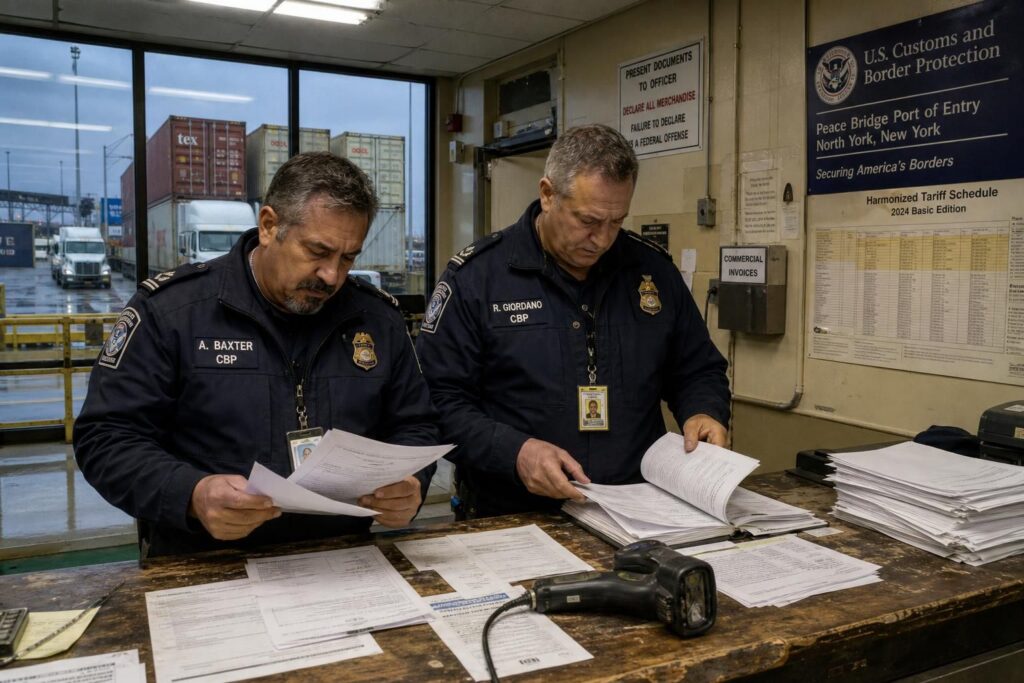
Customs rules put real pressure on cross-border sellers. The Peace Bridge is one of the busiest truck crossings on the continent, so paperwork and entry steps need to be right every time.
A skilled compliance partner knows tariff codes, trade agreements, and entry procedures inside and out. That know-how prevents delays that cost you money and frustrate your customers.
The New 2026-2027 Merchandise Processing Fees
Merchandise Processing Fees (MPF) are what US Customs charges on each formal entry. According to CBP’s FY2027 customs user fee adjustment, as summarized by brokers such as Mohawk Global and Juno Logistics, new rates started on October 1, 2026.
| Fee | FY2026 (ended Sept. 30, 2026) | FY2027 (from Oct. 1, 2026) |
|---|---|---|
| Minimum per entry | $33.58 | $34.58 |
| Maximum per entry | $651.50 | $670.86 |
| Rate | 0.3464% | 0.3464% |
The minimum applies to entries valued at about $9,984 or less. The maximum kicks in at about $193,665 or more.
Here’s the takeaway. Every small entry pays that flat minimum. Combining shipments into weekly entries means you pay it far less often.
How the Right Partner Keeps You Compliant
You also need to handle duty payments and re-export steps correctly to avoid costly mistakes. Local warehousing in the North York area makes customs much simpler, especially if you sell outside the US too.
The right NORTH YORK ONT 3PL services provider takes care of:
- Documentation and entry filings
- Tariff classification
- Border procedures and duty management
- Flexible fulfillment models that adapt as customs rules change
That frees your team to focus on sales. Customs stops being a headache and becomes an edge over slower competitors.
Trend #5 – Access to a Massive North American Consumer Base
Once customs runs smoothly, you open the door to a massive North American consumer base. And the U.S. retail e-commerce market keeps growing fast.
According to the U.S. Census Bureau’s Q2 2026 quarterly e-commerce report, US online retail sales hit $340.2 billion (seasonally adjusted). That’s up 12.2% from Q2 2025 and makes up 17.1% of all retail sales.
Total retail grew 6.7% over the same stretch. So online sales are growing nearly twice as fast as retail as a whole. That’s a strong reason to invest in US fulfillment now.
The Cross-Border Opportunity by the Numbers
- North America’s cross-border e-commerce market is growing at a compound annual rate of 19.7%.
- The sector is expected to grow from $86.45 billion in 2024 to $103.52 billion in 2025.
- The market is projected to reach $210.11 billion by 2029.
That growth means your NORTH YORK ONT 3PL services can reach millions of American shoppers who want fast, reliable delivery. The Peace Bridge in Erie County, NY, gives you a key logistics corridor straight into the US.
With the right setup, the border becomes a gateway, not a barrier. You can grow sales across the whole continent.
Trend #6 – Omnichannel Fulfillment (DTC, Retail, Marketplace) Under One 3PL
Chances are you sell in more than one place. Maybe you sell on your own website, stock retail stores, and list items on Amazon too.
Running fulfillment for all those channels separately eats time and money. A shared 3PL model fixes that by putting everything under one roof.
Providers like WNYFTZ offer omnichannel fulfillment that connects your Shopify store, Amazon account, and retail partners to one warehouse system. Your stock sits in one place, and the 3PL fills orders for every channel automatically.
What You Gain With One 3PL
- No duplicate warehousing: One inventory pool serves every channel.
- Lower handling costs: Fewer touches mean fewer fees.
- Smarter stock levels: Vendor-managed inventory programs help you avoid running out when demand spikes.
- One clear view: Real-time dashboards show inventory, kitting, and orders in one spot.
This setup reduces fulfillment costs significantly because you cut out the extra layers. Good cross border logistics specialists know that running each channel separately creates costly overlap.
Your team stops juggling multiple systems. You scale faster, react to market changes quicker, and serve customers better everywhere they shop. Call 716-823-2142 for a quote on omnichannel fulfillment services that fit your business.
Trend #7 – Real-Time API Integration and Inventory Visibility
Real-time API integration changes how you manage stock across the North York to Buffalo corridor. An API is simply a link that lets your store, warehouse, and shipping software share data instantly.
Modern warehouse and transportation systems let you track stock levels in real time. That helps you avoid both stockouts and overstocking, which both drain profits.
Accurate inventory data flows right into order fulfillment. Your sales channels, warehouse, and shipping tools work as one network, so there’s no manual data entry and far fewer human errors.
Why Shoppers Care About Tracking
According to Capital One Shopping in 2025, shoppers put a lot of weight on tracking:
- 88% of online shoppers say real-time tracking is critical to a good ecommerce experience.
- 64% of customers demand real-time shipment tracking on their orders.
Cross-border buyers want to know exactly where their package is. Timely updates build loyalty and cut down on “where’s my order?” emails that eat up your team’s time.
When you set up real-time API integration, you see every stock movement across all your fulfillment locations. Automation boosts order accuracy, so you can ship more orders with fewer resources. It also helps your 3PL deliver same-day and next-day shipments into the US, which gives you a real edge.
Trend #8 – Streamlined Reverse Logistics and Faster Returns
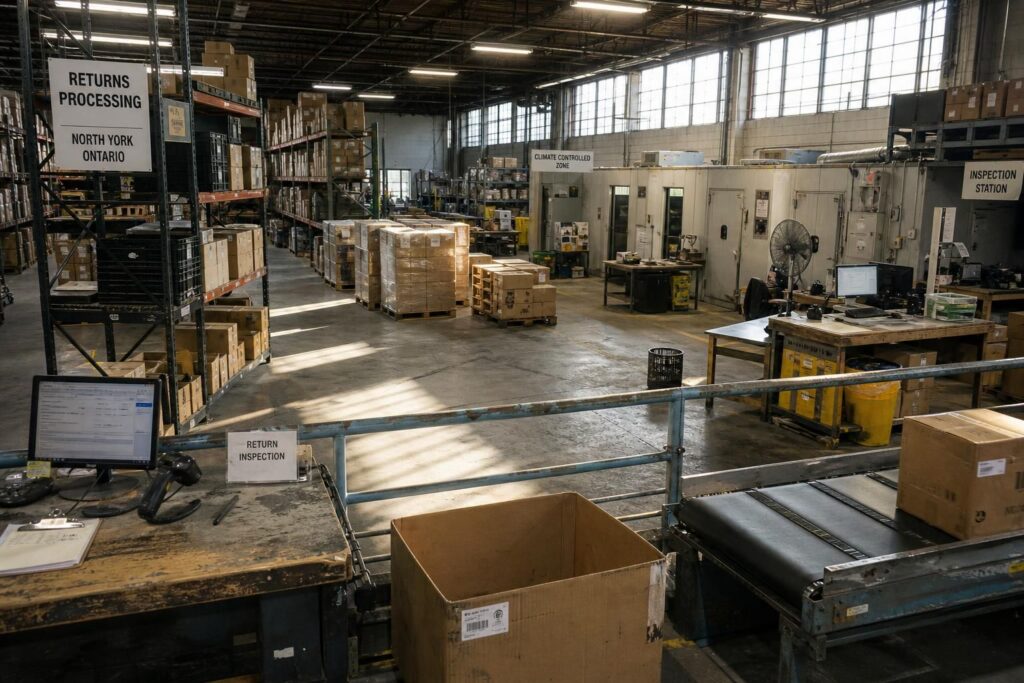
Great inventory visibility won’t help much if your returns process drags. WNYFTZ handles incoming returns through streamlined reverse logistics that keeps your operations moving fast.
Returned items get tracked with the same care as outgoing orders. You get status updates that match what your customers expect.
Here’s how a strong returns process helps your business:
- Inspection on arrival: Each return gets checked for restock eligibility, so your inventory stays accurate and your cash flow stays strong.
- Cold storage: Food, beverage, and pharmaceutical returns stay protected.
- One roof: Outgoing and returned shipments are managed together.
- Border help: Your partner provides customs support and cross-border shipping assistance for returns.
That support removes the usual slowdowns in reverse logistics operations. Brands with high return rates or temperature-sensitive products gain a real advantage through faster restocking and clearer inventory data.
Why Brands Choose WNYFTZ for NORTH YORK ONT Ecommerce Fulfillment?
North York area brands pick WNYFTZ because we deliver real results for cross border ecommerce fulfillment between Canada and the US. Our team manages your inventory, customs paperwork, and shipping so you can focus on growth.
Getting started is quick. Our five-step onboarding process looks like this:
- Account setup and tariff code review: two business days.
- First small inbound pallet arrives at the Buffalo FTZ for duty staging: within three days.
- API sync with your storefronts goes live with all SKUs: one day.
- Weekly consolidated customs entry is turned on: during your first billing cycle.
- Returns routing and inspection rules activate: within 24 hours of your first return.
Typical onboarding takes 7 to 10 calendar days in total. In most cases, you’re live across all channels and handling customs in under two weeks.
Call 716-823-2142 For a Quote
When you dial 716-823-2142, you get a real person right away. The WNYFTZ team jumps on urgent shipments and surprises fast, so your orders stay on track.
You get customized services that fit your business, not generic packages that waste your money and time.
Here’s what you can count on:
- Automated text and email updates that track shipments in real time
- Fast shipping via the I-90 and I-190 highways
- Full support with customs compliance and border administration
- Experts who handle both small parcels and full truckloads
- Urgent responses when timing matters most
Faster delivery, lower customs costs, and simpler returns all start with the right partner.
Ready to see what better NORTH YORK ONT ecommerce fulfillment can do for you? Call 716-823-2142 today for a quote on NORTH YORK ONT 3PL services in 2026 that help you serve the whole North American market.
People also ask:
1. What are NORTH YORK ONT 3PL services in 2026?
NORTH YORK ONT 3PL services in 2026 help you store, pack, and ship orders into the United States. By keeping your stock in a Buffalo, NY warehouse just 90 miles from the border, your products reach American buyers faster.
2. How does NORTH YORK ONT cross border logistics work?
You send bulk freight from NORTH YORK ONT across the border, clear customs once, and store the goods in Buffalo. From there, each order ships at domestic U.S. rates, saving you 30-40% on shipping costs.
3. Why is NORTH YORK ONT cross border ecommerce fulfillment growing?
Your shoppers want fast, affordable delivery, and a Buffalo hub delivers both. A 2024 National Retail Federation study found that 73% of U.S. online shoppers expect delivery within two days. Canadian sellers without a U.S. warehouse struggle to meet these speed and cost expectations.
4. What trends should sellers watch this year?
Watch for automated customs software like Flexport that cuts processing time in half, two-day shipping becoming standard, and simple return programs. Call 716-823-2142 to learn how these trends can help your business grow.
