

Why WNYFTZ Wins for Cross-Border Freight: Cross Docking, Transloading, Interdocking, and the Foreign Trade Zone Edge
Maximize Efficiency with Cross Docking, Transloading & Foreign Trade Zone!
Have you ever felt stuck waiting for your cross-border shipments while costs keep climbing?
You’re not alone. Many business owners dealing with Canada-U.S. freight face the same frustration: slow deliveries and unpredictable expenses.
Here’s the good news.
According to a study from the Council of Supply Chain Management Professionals, companies that implement cross-docking achieve an average of 18% in warehousing cost savings and a 22% reduction in inventory levels.
These savings are real, and they’re within your reach.
I’m going to walk you through exactly how WNYFTZ uses cross docking, transloading, interdocking, and the foreign trade zone advantage to speed up your final mile delivery while trimming your budget. By the end of this, you’ll see why smart business owners choose this approach.
Let’s get into it.
Key Takeaways
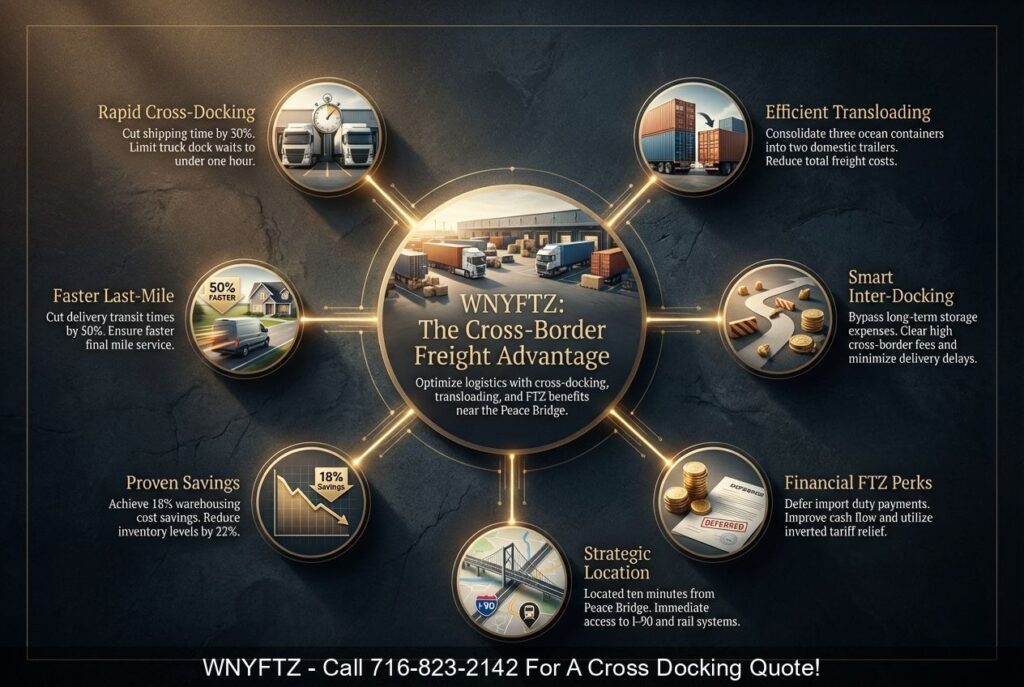
- WNYFTZ uses cross-docking to cut shipping times by up to 30% and reduces truck waiting time at the dock to under one hour.
- Transloading at Tri-Link FTZ saves money on freight costs by consolidating shipments and allows faster cargo redirection across Canada and the U.S.
- Inter-docking, promoted in December 2025 for Ontario, helps clear high cross-border fees while minimizing delivery delays without long-term warehousing expenses.
- Foreign Trade Zone status lets companies defer duty payments on Canadian imports, helping cash flow and sometimes lowering duties through inverted tariff relief.
- Located ten minutes from the Peace Bridge with access to I-90 and major rails, WNYFTZ gives rapid cross-border service between Western New York and Southern Ontario.
Send Us A Message or Call Us At 716-823-2142
Understanding the Different Supply Chain Strategies
Each supply chain strategy offers a different way to move your goods faster and more efficiently. Knowing how these methods work gives you a real edge, especially when you need reliable last mile delivery.
Let me break down the four main strategies that can transform your cross-border operations.
Cross-Docking
Cross-docking means moving goods straight from inbound trucks to outbound trucks with almost no storage. You save time since sorting and loading happen immediately by destination.
This process keeps pallets intact, so there’s less chance of damage. Sorting staff handle items quickly for direct shipping to their next stop, which speeds up your deliveries dramatically.
According to the Council of Supply Chain Management Professionals, companies using cross-docking see an average of 18% in warehousing cost savings. A report from Capgemini Consulting found that organizations adopting this method improved distribution efficiency by 29%.
That’s real money back in your pocket.
Tri-Link FTZ uses cross-docking to meet the fast needs of retail supply chains. With tight schedules and careful coordination, trucks rarely stay at the dock longer than one hour.
Businesses handling pre-sorted or pre-packaged products see up to 30% faster shipping times compared to common warehousing methods.
In a high-turnover setup like Tri-Link FTZ, speed and accuracy in cross-docking protect against delays while lowering labor costs.
Many companies choose cross-docking for perishables or retailers needing rapid restocks across regional hubs. The strategy also reduces storage expenses and helps you manage inventory more efficiently during every step of distribution.
Transloading
Transloading helps you handle freight from international ports with ease. Goods arrive in ocean containers, get unloaded and sorted, then move to trucks or trains for domestic delivery.
Tri-Link FTZ specializes in this process, supporting importers and manufacturers who use multiple transportation modes.
Transloading offers significant cost savings when ocean containers can be consolidated. The cargo in three 40-foot ocean containers typically fits into two 53-foot domestic trailers.
That’s one less truck to pay for on every shipment.
You can take advantage of short-term storage while shipments are inspected or consolidated, which reduces unnecessary waits at busy ports. Consolidating several incoming containers into fewer outbound trucks saves money on freight costs.
This flexibility makes it easier to redirect products to different destinations as demand changes. Industries like construction benefit because materials can be reallocated quickly across sites without long delays or high port storage fees.
Quality remains a top priority through container breakdown protocols and real-time inventory tracking systems. Automated and manual checks help catch damages or errors during handling. This limits risk even though goods may pass through many hands before final delivery.
These careful steps keep your supply chain efficient while preventing costly mistakes that can slow business down.
Inter-Docking
Inter-docking at WNYFTZ helps you move freight quickly across the US-Canada border, skipping long-term warehouse storage. In December 2025, service promotions rolled out in Mississauga, Hamilton, and the Greater Toronto Area.
These campaigns showed how inter-docking clears high cross-border fees and cuts delivery delays. You’ll find this option useful if warehousing costs or shipping hold-ups frustrate your business operations.
According to FreightWaves, the Peace Bridge in Buffalo handled 892,838 truck crossings in 2023, making it one of the busiest cross-border gateways.
That volume creates opportunities but also bottlenecks.
WNYFTZ markets inter-docking to Ontario clients dealing with rising logistics expenses. The process speeds up cargo transfers and keeps shipments moving without extra budget impacts from traditional storage.
If you need a faster route for goods while managing shipping costs in busy trade corridors, this service could reshape your distribution strategy. It works especially well when paired with Foreign Trade Zone advantages.
Foreign Trade Zones
Foreign Trade Zones (FTZs) sit in special areas inside the United States. These sites do not count as U.S. customs territory for tariff rules.
This means you can bring goods into an FTZ and delay paying duties or tariffs until moving those goods into U.S. commerce. Many companies use this option to save on costs and improve cash flow, especially if some items stay longer or ship elsewhere.
One of the main advantages of an FTZ is the ability to defer duty payments until goods leave the zone and enter U.S. commerce. This deferral can create significant cash flow benefits by allowing you to hold imported inventory without immediate duty payment.
The FTZ program provides another significant advantage: finished products sometimes have a lower duty rate than their parts. This rule, called inverted tariff relief, is a powerful tool.
According to the Foreign-Trade Zones Board’s 2023 Annual Report to Congress, there were 197 active FTZ programs across the United States, employing approximately 550,000 people at approximately 1,300 active operations.
That’s a massive network supporting American business.
Sectors like automotive, aerospace, electronics, pharma, and logistics use these zones to change up supply sources or adjust pricing fast if tariffs shift. Technology systems now help automate customs filings and keep inventory records accurate for compliance needs.
Some businesses even get subzones created specifically for their specialized operations or projects within the FTZ network. Next, discover how cross-docking and transloading speed up your shipping process while keeping costs down.
Benefits of Cross-Docking and Transloading
Cross-docking and transloading give your business smart ways to move freight faster and cut extra costs. Let me show you the specific benefits you can expect.
Faster shipping times
Goods move directly from receiving docks to outbound trucks, speeding up the process by as much as 30 percent. This method removes long storage stops, so shipments get to your customers faster across North America.
Transloading helps transfer goods between ships and trucks or trains quickly, supporting quick regional delivery and reducing downtime.
Tri-Link FTZ’s process keeps every truck at the dock for less than one hour. This cuts down on transit delays and gets products back on the road fast.
Businesses using these services have reported delivery time improvements of up to 40% and a reduction in transportation costs by 30%.
That’s speed you can measure.
E-commerce companies and those handling perishables benefit most. These sectors rely on speed to keep shelves stocked and shoppers happy.
Streamlined distribution also makes last-mile delivery more efficient since products are already consolidated and sorted for final routes.
Reduced storage costs
Cross-docking moves freight straight from inbound trucks to outbound transport. Rent, labor, and utilities tied to long-term warehousing do not pile up for your business.
Cash stays in your pocket instead of being locked into inventory holding costs. Most companies see stronger profit margins due to these lower expenses.
Research shows that cross-docking can reduce warehousing costs by 20 to 30%.
Those savings add up fast when you’re moving high volumes.
Transloading combines multiple shipments so goods spend less time at storage sites or ports. Using a Foreign Trade Zone like WNYFTZ can defer duty payments on Canadian imports, which helps your cash flow even further.
Storage needs shrink especially if you handle high-turnover products or want more competitive pricing in cross-border freight markets.
Improved inventory management
Moving from reduced storage costs, you’ll also notice how cross-docking and transloading improve inventory management. Faster product flow means less time sitting in warehouses.
This directly lifts your inventory turnover rates. Real-time tracking with RFID tags or IoT devices lets you see where each shipment stands as it moves through the process.
You gain more control as systems like Warehouse Management Systems (WMS) and Transportation Management Systems (TMS) help manage schedules and optimize stock levels. These tools have become essential for modern freight operations.
Flexible allocation of goods becomes easier too, especially if your shipments need to reach different destinations quickly. Transloading allows you to break down loads for repalletizing or sending items to multiple locations without losing sight of any box or pallet along the way.
This simplified approach reduces errors that lead to shortages or overstock. I’ve seen this firsthand while managing freight at busy hubs like WNYFTZ during seasonal peaks.
Accurate demand forecasting then helps keep shelves filled just right, minimizing risk for business owners aiming to meet customer demand every day.
The Role of Cross-Docking in Last-Mile Delivery
Cross-docking shapes the speed and accuracy of last-mile delivery by making freight more flexible and efficient. This shift in logistics means your business can keep up with growing demand while cutting costs along each supply chain step.
How it’s transforming delivery dynamics
Goods move from incoming trucks to outgoing vehicles with almost no storage time.
This rapid transfer enhances efficiency and speed, minimizing the time products spend in distribution centers. By minimizing storage time and optimizing routing, businesses can overcome many challenges associated with last-mile delivery.
This process helps cut delivery transit times by up to 50 percent for many businesses. E-commerce and retail companies gain an edge because faster shipping boosts customer satisfaction.
Route planning improves as technology streamlines sorting and tracks goods in real-time. You also avoid unnecessary handling, so products reach their last destination quicker and with less risk of damage.
Supply chains stay flexible and respond swiftly to market changes. This supports just-in-time logistics, a critical advantage in today’s fast-paced markets.
Home Depot reported that 55% of its deliveries for in-stock SKUs are now made either the same day or the next day, more than triple its 2022 amount, powered by nearly 200 distribution facilities including cross-dock facilities.
That’s what effective cross-docking can do for a major retailer.
With fewer stops between warehouses, you spend less on transportation costs while helping support sustainability goals by lowering your carbon footprint. More regions around the world now use this approach due to its strong impact on modern freight strategies.
Benefits for final mile delivery
This shift in delivery dynamics brings real value to your last-mile logistics. Cross-docking at WNYFTZ enables faster order fulfillment for North American customers, so you meet tight shipping timelines with less stress.
Efficient consolidation ensures fewer partial loads, cutting down on delays and wasted trips.
You also reduce storage costs and labor because products move from inbound trucks directly onto outbound vehicles without long waits in a warehouse. Rapid turnover of perishables limits the risk of spoilage.
This is vital for supermarkets and food retailers needing to restock shelves quickly.
Pharmaceutical manufacturers benefit from reduced handling steps. Critical supplies get to healthcare facilities faster and with better control over inventory levels.
Accurate demand forecasting helps prevent out-of-stock issues during final mile delivery, keeping your customers satisfied every step along the way.
Why Choose WNYFTZ for your Cross-Docking Needs?
WNYFTZ sits just ten minutes from the Peace Bridge, giving you rapid cross-border access between Canada and the U.S.
The Peace Bridge is one of the busiest on the Canada-United States border, with over one million trucks crossing it each year.
That volume means opportunity for your business.
Immediate connection to Interstate 90 and major rail systems speeds up your shipments across Ontario, Mississauga, Greater Toronto Area, Niagara Region, Brampton, Oakville, and Hamilton. The facility supports cross docking and transloading with advanced infrastructure that boosts order fulfillment while slashing long-term warehousing costs.
Duty deferral on Canadian imports helps improve your cash flow by cutting upfront customs payments. This is a real benefit for importers seeking lower overheads.
Integrated technology delivers real-time updates so you meet customs rules without guesswork or delay.
Transparent pricing means no surprises. Clear communication keeps you in control at every stage.
A skilled team works directly with each business owner to solve shipping problems such as high transport costs or border delays faced by companies in Western New York and Southern Ontario. Cross-docking solutions go into effect starting December 2025 through January 2026.
This gives you a strategic edge over competitors still relying on outdated models. You get speed, savings, and service all in one place.
People also search for:
1. What makes WNYFTZ different from other cross-border freight facilities?
We combine fast cross-border logistics with Foreign Trade Zone tax breaks, all just 10 minutes from the Peace Bridge. This unique location helps you move goods faster while keeping more cash in your pocket.
2. How do cross docking and transloading services benefit my business?
Cross docking and transloading let you skip expensive warehousing fees by moving your freight directly from one truck or train to another for immediate delivery.
3. What advantages does the Foreign Trade Zone provide?
You can delay or even skip paying U.S. customs duties until your product actually enters the domestic market. This deferral improves your cash flow and gives you the freedom to repackage or process goods without a tax penalty.
4. Can WNYFTZ handle complex freight operations?
Absolutely, as our team coordinates everything from simple transfers to complex interdocking for consolidated shipments. We handle the carrier logistics so your supply chain stays efficient and your products keep moving.
