

CALEDON ONT Cross Border Ecommerce Fulfillment & 3PL Services – Call 716-823-2142
Does this sound familiar? Your ecommerce business ships across the Canada-U.S. border, but your fulfillment costs just keep climbing no matter what you try.
You’re managing inventory on both sides of the border, chasing real-time package updates, and dealing with returns that cost more than they should.
Here’s what the numbers show: cross-border ecommerce trade between Canada and the U.S. exceeded $80 billion in 2025, and that number keeps rising. CALEDON ONT ecommerce fulfillment has never been more competitive, or more full of real opportunity.
Your customers expect fast shipping and accurate orders. But customs delays and tangled logistics eat into your profits.
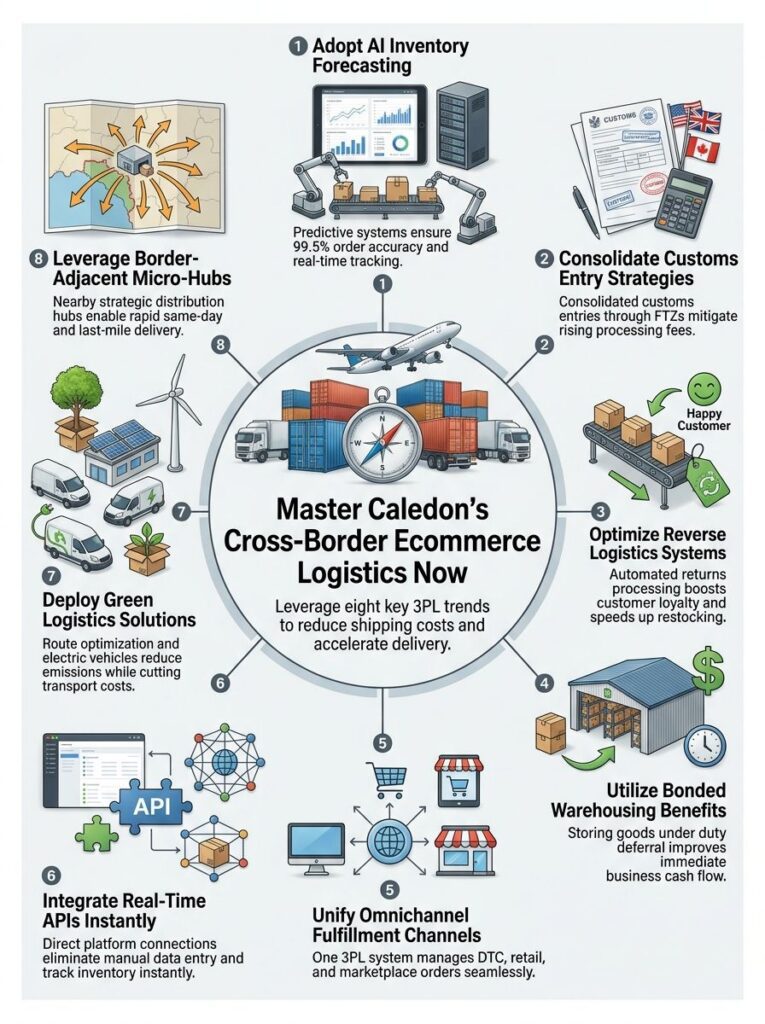
This report breaks down eight major trends reshaping CALEDON ONT 3PL services in 2026. You’ll see how AI sharpens order accuracy, how tariff reforms should change your shipping strategy, and why reverse logistics gives you a genuine competitive edge. You’ll also find out how bonded warehousing saves money and how micro-hubs near the border speed up delivery times.
Read on. I’ll walk you through exactly what’s working right now, and how to put it all to use for your Caledon business.
Key Takeaways
- Cross-border ecommerce trade between Canada and the U.S. exceeded $80 billion in 2025, with the market projected to grow from $9.4 billion to $36.8 billion by 2034.
- AI-driven inventory forecasting and real-time tracking are now essential requirements. According to Capital One Shopping’s 2025 data, 88% of online shoppers consider real-time tracking critical for their purchasing decisions.
- U.S. Customs Merchandise Processing Fees increased to $651.50 maximum per entry in October 2025. On top of that, CBP indefinitely suspended the $800 de minimis duty-free exemption as of June 2026, making consolidated weekly customs entries through Foreign Trade Zones financially necessary for your business.
- Returns management services are growing at 16.2% annually, turning reverse logistics into a competitive advantage for businesses managing cross-border ecommerce fulfillment.
- Buffalo’s WNYFTZ location offers strategic advantages including proximity to Peace Bridge, duty deferral benefits, and access to major transport networks for faster last-mile delivery.
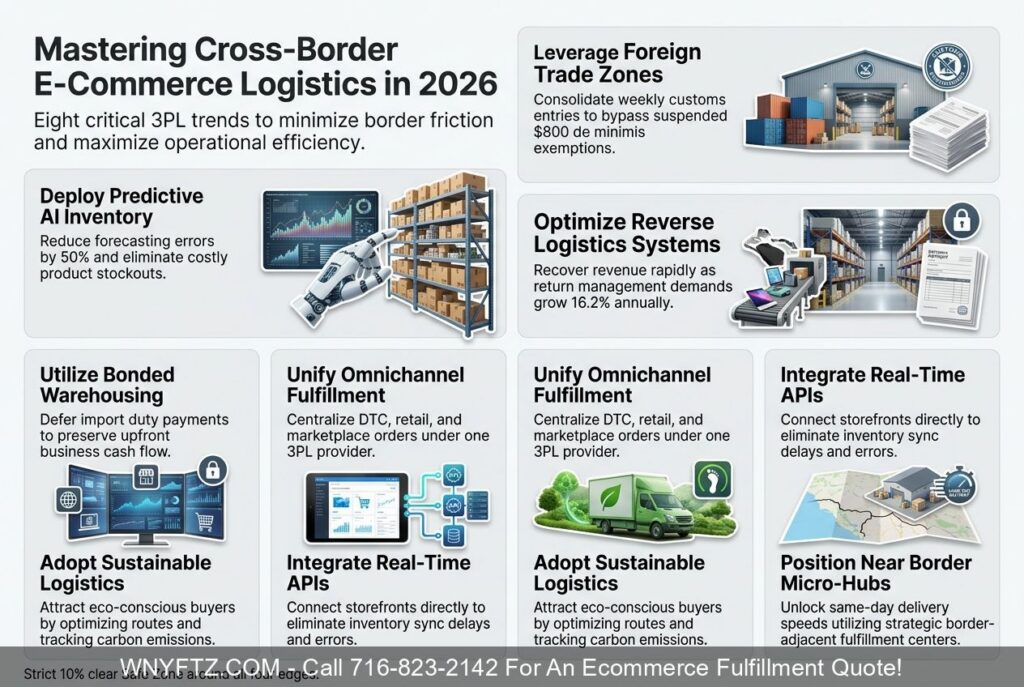
Market Overview – Cross Border Ecommerce Fulfillment & 3PL Landscape for CALEDON, ONT
Your cross-border ecommerce fulfillment needs are expanding fast, and the market data backs that up. The warehousing and distribution segment holds the largest share at 32.5%, valued at $3.06 billion in 2025 and projected to grow at 13.8% annually.
Transportation services make up 24.8% of the market and are set to grow at 14.5% per year. Customs clearance services are expanding even quicker at 15.8% annually, driven by rising regulatory requirements across cross-border ecommerce.
For CALEDON ONT businesses, this growth means more options than ever. But it also means you need to pick the right partner to handle your CALEDON ONT cross border logistics strategy.
- Direct-to-consumer channels are forecast to grow at 15.4% annually, showing a major shift in how CALEDON ONT ecommerce fulfillment operates.
- Returns management services are growing fastest at 16.2% per year, driven by higher return rates that demand careful attention.
- Over one-third of companies already use 3PL services, and that number keeps climbing as businesses pursue efficiency and cost savings.
The National Association of Foreign Trade Zones highlights that foreign trade zone benefits can save thousands of dollars annually for qualified inventory. That makes your location near Buffalo, NY and access to WNYFTZ increasingly valuable for managing CALEDON ONT 3PL services 2026 operations.
Trend #1 – AI-Driven Inventory Forecasting and Order Accuracy Are Becoming Table Stakes
One critical shift separates thriving cross-border operations from struggling ones. Your inventory management strategy now demands artificial intelligence and data-driven methods to stay ahead.
This marks the move from basic stock counting to predictive systems that anticipate customer demand before orders even arrive.
Why AI Accuracy Is Now Non-Negotiable
AI-driven inventory forecasting has become essential for staying competitive in cross border logistics. Your customers expect order accuracy rates above 99.5% from third-party logistics partners. That level of precision isn’t optional anymore.
Real-time inventory tracking matters a great deal, too. According to Capital One Shopping’s 2025 data, 64% of customers demand this feature as a baseline expectation. Automated reordering in warehouse management systems directly improves your delivery times and stock availability.
Real-time tracking is essential for a positive shopping experience, according to Capital One Shopping’s 2025 data, with 88% of online shoppers considering this feature critical for their purchasing decisions.
The Real Business Impact
Businesses that use AI-driven inventory forecasting see measurable gains in customer satisfaction. Your operations gain visibility into demand patterns, cut excess stock, and minimize stockouts through these systems.
According to 2026 supply chain research by McKinsey and Company, AI-powered supply chain forecasting reduces forecasting errors by 20% to 50% and cuts lost sales from product unavailability by up to 65%. That’s not a marginal improvement. It’s a fundamental shift in how you protect revenue.
Your 3PL partner’s ability to forecast inventory trends directly impacts your bottom line and your customer retention rates. Companies that use these technologies consistently outperform competitors who still rely on traditional forecasting methods.
Your competitive edge depends on adopting AI tools now, not waiting for a future cycle.

Trend #2 – De Minimis and Tariff Reform Are Reshaping Cross Border Parcel Strategy
Your cross border logistics strategy needs a serious rethink right now. U.S. Customs and Border Protection increased Merchandise Processing Fees to a maximum of $651.50 per entry effective October 2025.
Then, according to June 2026 regulatory updates from U.S. Customs and Border Protection (CBP), things got even more significant. On June 24, 2026, CBP issued interim final rules that indefinitely suspended the $800 de minimis duty-free exemption for all modes of importation. This forces sellers to use formal or informal entry procedures and pay applicable duties on every shipment crossing the border.
These two changes together make your old parcel strategy obsolete. You need a new approach now.
How Foreign Trade Zones Protect Your Margins
De minimis and tariff reforms are pushing businesses to optimize customs costs. Using consolidated weekly customs entries through Foreign Trade Zones has gone from a smart financial move to a near-essential one for your CALEDON ONT operations.
Consolidated entries through FTZs significantly reduce the impact of higher per-entry fees on your cross border ecommerce fulfillment costs. Research by FTI Consulting in 2025 shows substantial cost reduction on tariffs, duties, taxes, and customs fees through FTZ programs. Your bottom line improves when you partner with a 3PL that understands these tariff strategies.
Your inventory turnover becomes more profitable too. You can eliminate duties on re-exported or destroyed goods, creating direct financial benefits for your CALEDON ONT business with dynamic product flows.
Trend #3 – Reverse Logistics and Returns Management Are Now a Competitive Advantage
As tariff reforms reshape your cross-border parcel strategy, a new challenge shows up on the return side of your supply chain. Your customers expect seamless returns just as much as fast shipping. And this expectation is turning returns management into one of your most powerful competitive tools.
Returns management services are growing at the fastest rate of 16.2% annually through 2034. Smart businesses are investing heavily in this area to stand out from competitors.
Based on the 2025 Retail Returns Landscape report by the National Retail Federation (NRF), the average ecommerce return rate sits at roughly 19.3%, contributing to an estimated $849.9 billion in total annual retail returns. That scale makes it clear why reverse logistics has to be treated as a core operational strategy, not just an administrative task.
How Smart Returns Processes Work
Efficient reverse logistics lets your Caledon ONT cross border ecommerce fulfillment operations handle rising return rates while keeping customers satisfied and loyal. Real-time inventory tracking speeds up the accuracy of returns processing for your cross-border shipments. Customers get refunds faster and you regain sellable inventory quicker.
Automated warehouse management systems let your team restock returned items rapidly and track them with precision. Barcode technology minimizes errors throughout the entire process.
A Real-World Example from Caledon
A Caledon direct-to-consumer electronics seller deployed an integrated returns workflow routed through a single bonded micro-hub handling cross-border returns and restocking. Before this change, average time-to-restock was 12 days, with 18% of returns requiring manual inspection.
After implementing integrated returns routing and barcode-driven scans, time-to-restock dropped to 3 days. The manual inspection rate fell to 6% across 420 returns processed over 60 days. Streamlining returns through one cross-border micro-hub turned returns from a loss leader into recoverable inventory quickly enough to re-list items within the same selling season.
Your 3PL partner should offer integrated returns management solutions that cut operational headaches, freeing you to focus on growing your business. Enhanced visibility into your returns data also helps you spot product issues before they become bigger problems.
Businesses that master reverse logistics gain a clear advantage in the competitive cross border ecommerce fulfillment landscape. It transforms what many see as a burden into a genuine opportunity to strengthen customer relationships and improve profitability.
Send Us A Message or Call Us At 716-823-2142
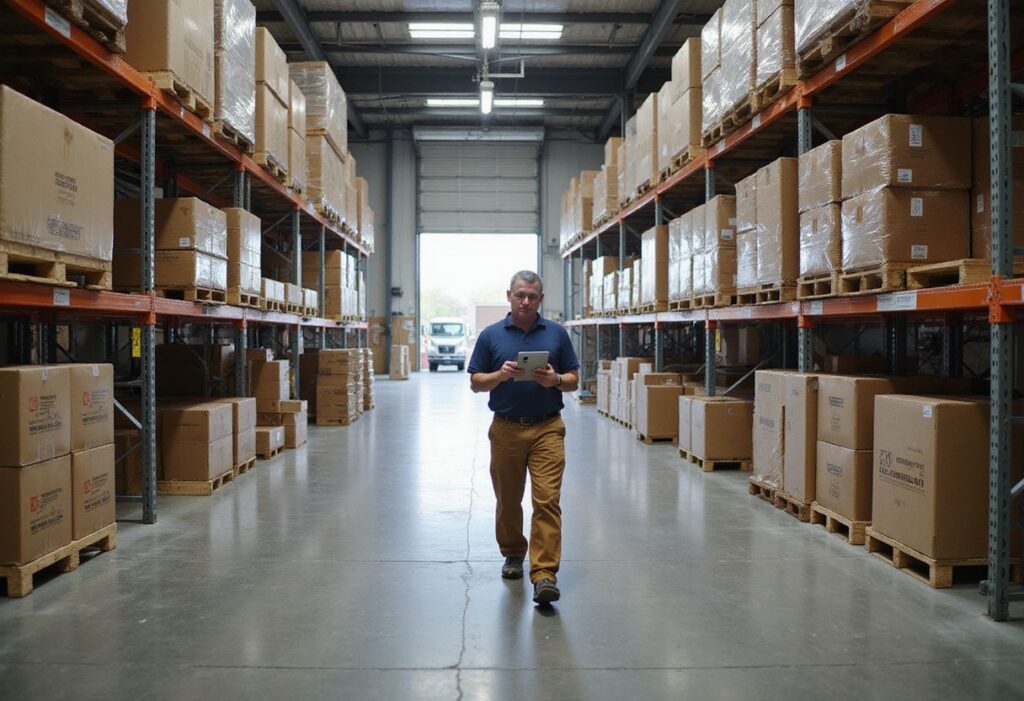
Trend #4 – Bonded Warehousing and Duty Deferral Are Going Mainstream
Bonded warehousing is changing how your CALEDON ONT cross border logistics operations manage inventory and cash flow. U.S. Customs and Border Protection (CBP) regulates these facilities, letting you store imported goods without paying duties right away.
Your goods stay in a bonded warehouse until they enter U.S. commerce or you export them elsewhere. That flexibility gives you real control over your supply chain timing and financial planning.
What the Market Numbers Tell You
The Bonded Warehouse Market reached $14.4 billion in 2025 and will grow to $25.4 billion by 2035 at a compound annual growth rate of 5.9%. That growth means more providers now offer bonded warehousing services, giving your CALEDON ONT cross border ecommerce fulfillment strategy more options.
Transitioning from Foreign Trade Zones to bonded warehousing reduces your administrative burden and delivers real cost savings. Many businesses report improved cash flow and simpler customs processes after making this change.
A Caledon Case Study in Savings
A mid-size Caledon apparel retailer used bonded warehousing at WNYFTZ for a seasonal apparel batch of 5,000 units, stored in a bonded warehouse rather than paying duties at import into Canada immediately.
- Duty deferral saved an estimated $18,750 in upfront duty payments and improved cash flow.
- Consolidated weekly customs entries reduced Merchandise Processing Fees by approximately $1,300 over 3 months compared to daily entries.
- Moving seasonal stock into bonded storage and consolidating entries weekly freed up working capital in a single quarter.
Your competitive advantage lies in understanding bonded warehousing’s practical benefits for re-exporters and storage-focused operations. Predictable customs timelines become your reality instead of a distant goal.
Companies managing CALEDON ONT cross border logistics find that bonded warehousing fits their needs better than traditional FTZ arrangements. Regulatory compliance gets simpler, and your team spends less time on paperwork. Services like those from tkSCS provide comprehensive management, keeping your operations smooth while meeting all CBP requirements.
Trend #5 – Omnichannel Fulfillment (DTC, Retail, and Marketplace) Is Consolidating Under One 3PL
Your business operates across multiple sales channels. You sell direct-to-consumer through your website, stock products in retail stores, and list items on major marketplaces, all at the same time.
Managing fulfillment across those separate systems creates chaos, inventory conflicts, and unhappy customers. Over one-third of companies currently use 3PL providers, and many more are considering it for future omnichannel operations in CALEDON ONT cross border ecommerce fulfillment.
A single 3PL partner synchronizes your disconnected fulfillment processes into one integrated network. It removes the technology limitations that drag down order management and fulfillment across channels.
- Your DTC orders, retail shipments, and marketplace fulfillment all flow through centralized logistics models.
- Greater operational visibility cuts costly errors across every channel.
- With 28.4% of companies planning to adopt multiple distribution centers for better geographic targeting, you gain access to strategically positioned warehouses that accelerate CALEDON ONT cross border logistics.
This unified approach transforms your fulfillment from a weak point into a competitive advantage. You compete effectively in cross-border ecommerce without managing separate systems, separate teams, or separate headaches.
Trend #6 – Real-Time API and Platform Integration Is Defining 3PL Selection
Real-time API integration has become a core requirement for CALEDON ONT cross border ecommerce fulfillment partners. This shift is reshaping how you select a 3PL provider.
Direct integration with major platforms like Shopify and Amazon gives you a single source of truth for inventory and order status. It eliminates manual data reconciliation that slows your operations. Automated warehouse management systems speed up fulfillment and improve reliability, so orders move faster from warehouse to customer.
What Real API Integration Delivers
Since 64% of customers expect real-time tracking, API-driven data exchange has become critical for transparency. 3PLs offering direct integration enable faster, more accurate order processing and inventory updates that keep pace with your growth.
A Caledon merchant storefront connected to a WNYFTZ test API to validate real-time inventory and order status flows before full rollout. Over a 30-day sandbox run processing 1,200 simulated orders, automated API acknowledgments reduced inventory mismatch events from 24 to 2. Order status update latency dropped from an average of 22 minutes to under 12 seconds.
The sandbox run proved that API-first integration eliminates common reconciliation lag and delivers near-instant order updates.
What to Look for in a 3PL Partner
Integration capabilities let CALEDON ONT businesses scale fulfillment as order volumes grow, without adding complexity. Real-time communication via text and email aligns with what your customers expect for shipment visibility.
Seamless platform connections reduce errors, speed up processing times, and give you the visibility you need to compete in cross border logistics. When you evaluate 3PL partners for your CALEDON ONT cross border ecommerce fulfillment needs, prioritize those offering proven API capabilities and a track record of successful integration with your existing systems.
Trend #7 – Sustainability and Green Logistics Are Influencing Fulfillment Decisions
Your 3PL partner’s API integration capabilities now connect directly to your sustainability metrics and carbon tracking systems. This technological foundation sets the stage for the next critical shift in how you make fulfillment decisions.
Green logistics practices have moved from nice-to-have features to essential requirements for your CALEDON ONT cross border ecommerce fulfillment strategy. Your customers expect you to measure and reduce your environmental footprint, and your 3PL selection now depends on their commitment to sustainable operations.
According to a recent ecommerce consumer sentiment study by Descartes and SAPIO Research, 56% of consumers aged 18 to 34 have actively reduced their online shopping due to environmental concerns, and 38% regularly base purchasing decisions on a company’s environmental impact. That’s not a trend you can afford to ignore. It’s a direct hit to sales if you don’t act.
How Green Logistics Shapes Your Operations
Electric vehicles and crowdshipping solutions are reshaping how your last-mile logistics operate across the cross-border landscape. You gain real advantages when your fulfillment partner deploys these technologies to cut emissions and boost customer satisfaction at the same time.
Research from 2020 to 2025 shows that efficient last-mile logistics reduce environmental impact while strengthening your brand reputation. Your CALEDON ONT cross border logistics network must balance environmental, economic, and social factors to stay competitive in 2026 and beyond.
Your fulfillment decisions now reflect a broader shift toward green practices that influence network design and carrier selection. You work with 3PLs that measure carbon emissions, optimize delivery routes, and invest in cleaner transportation methods. Innovative logistics solutions, combined with supportive government policies, are shaping future sustainability strategies across the industry.
Green logistics are no longer optional. They define competitive advantage in cross border ecommerce fulfillment for forward-thinking business owners.
Trend #8 – Border-Adjacent Micro-Hubs Are Accelerating Last-Mile and Same-Day Delivery
Your Caledon, ONT business gains a major speed advantage through border-adjacent micro-hubs that cut delivery times across North America. Buffalo’s strategic location puts 40% of North America’s population within a one-day drive. That means your customers get orders faster and your fulfillment costs drop significantly.
Facilities like WNYFTZ feature multi-truck docks that minimize storage time. Your inventory moves quickly from warehouse to customer doorstep without unnecessary delays.
Cross border logistics from Caledon, ONT now reaches new levels of efficiency because micro-hubs sit close to major highways like I-90 and I-190. Your same-day and next-day delivery options expand significantly for customers in the Greater Toronto Area, giving you a competitive edge that drives customer loyalty.
Spatial and statistical studies confirm that border-adjacent logistics platforms accelerate deliveries for time-sensitive and seasonal products. These micro-hubs are essential for businesses shipping across the U.S.-Canada border.
Your cross border ecommerce fulfillment strategy gets faster, smarter, and more cost-effective when you use these strategically positioned distribution centers.
Why Buffalo, NY and WNYFTZ Fit the 2026 Cross Border Model
Buffalo, NY and WNYFTZ represent the strategic foundation for your cross border ecommerce fulfillment strategy as you scale into 2026 and beyond.
| Strategic Advantage | How It Serves Your Caledon Business |
|---|---|
| Proximity to Peace Bridge | WNYFTZ sits just 10 minutes from the Peace Bridge, cutting your border crossing time and operational delays significantly. Fast access means faster shipments to Canadian customers and less logistics friction. |
| Duty Deferral Benefits | Your cash flow improves when WNYFTZ defers customs payments on Canadian imports through its Foreign Trade Zone status. Postponing duty payments lets you keep more working capital in your business right now. |
| Major Transport Networks | Interstate 90 and regional rail networks converge near Buffalo, connecting you to major U.S. and Canadian markets quickly. Multi-modal transportation options reduce shipping costs and expand your delivery zones. |
| Comprehensive 3PL Services | Cold storage, cross-docking, and in-house customs management operate under one roof at WNYFTZ. Consolidating services with one partner cuts coordination headaches and strengthens supply chain control. |
| Operational Scale and Reliability | WNYFTZ processes over 4.5 million deliveries annually, proving its ability to handle your volume growth without service degradation. That scale shows real-world reliability when peak seasons hit. |
| Regulated Shipment Compliance | If you ship alcohol or other controlled goods, WNYFTZ maintains the necessary permits and compliance protocols in-house. Specialized handling removes regulatory risk from your shoulders entirely. |
| Cost Reduction Through Location | Border-adjacent positioning at WNYFTZ cuts crossing delays and operational expenses compared to inland fulfillment centers. Location advantage translates directly into margin improvement for cross border orders. |
| 2026 Cross Border Model Alignment | Buffalo and WNYFTZ embody the micro-hub strategy reshaping ecommerce logistics. They accelerate last-mile delivery while maintaining bonded warehouse capabilities, which is exactly what forward-thinking retailers need moving forward. |
Businesses operating from Caledon gain a competitive edge by using WNYFTZ’s Foreign Trade Zone designation. Your inventory moves through customs faster, your duties get deferred, and your fulfillment costs drop measurably.
Integration with WNYFTZ aligns perfectly with 2026 trends around real-time API connectivity and omnichannel consolidation. The facility supports seamless data exchange, letting you manage DTC, retail, and marketplace orders from one platform.
De minimis reforms and tariff changes are reshaping how cross border parcels flow between Canada and the U.S. WNYFTZ’s in-house customs team handles these shifts, protecting your margins from sudden regulatory changes.
Sustainability initiatives are gaining ground in fulfillment decisions, and WNYFTZ’s consolidated operations reduce your carbon footprint significantly. Fewer border crossings and optimized routing mean greener logistics without sacrificing speed.
Returns management gets simpler when reverse logistics flow through a single bonded warehouse. WNYFTZ handles Canadian returns with the same precision it applies to forward shipments. Your location just north of the border makes Buffalo the logical hub for scaling operations efficiently.
How CALEDON, ONT Businesses Can Use These 8 Trends Now
Your CALEDON ONT cross border ecommerce fulfillment strategy needs updates now to stay competitive in 2026. These eight trends offer concrete actions you can take today to reduce costs and improve customer satisfaction.
Cut Costs and Speed Up Shipping
- Start using shipment consolidation services right now to cut your transportation costs by an average of 18% across all shipments.
- Adopt pick and pack services with barcode technology at average fees of $3.64 per item to improve accuracy and speed.
- Deploy cross-docking strategies at your warehouse to minimize storage time and boost delivery speeds by up to 40%.
- Shift to public warehousing for flexible inventory management without committing to long-term leases or fixed overhead costs.
Optimize Customs and Cash Flow
- Take advantage of weekly customs entries through FTZ to streamline shipment processing and cap Merchandise Processing Fees, especially now that the $800 de minimis exemption has been suspended.
- Explore bonded warehousing options to defer duties and improve your cash flow management throughout the year.
- Choose integrated 3PL services that combine warehousing, customs clearance, and logistics support for cost savings of 30-40% at up to 1,000 orders per month.
- Implement vendor-managed inventory programs to optimize stock levels and process orders faster than your competitors.
Build Smarter Operations
- Install real-time tracking systems for inventory and customer updates, since 64% of customers expect this level of visibility.
- Evaluate your current CALEDON ONT cross border logistics provider to ensure they offer API integration and real-time platform connectivity.
- Launch a reverse logistics program now to turn returns into a competitive advantage rather than a cost center.
- Build omnichannel fulfillment capabilities that handle direct-to-consumer, retail, and marketplace orders from a single 3PL partner.
Predictions for Cross Border Ecommerce Fulfillment in 2027 and Beyond
Acting on these eight trends today positions your business to thrive in the rapidly shifting cross-border logistics landscape ahead. The cross-border ecommerce fulfillment market will grow from $9.4 billion in 2025 to $36.8 billion by 2034, expanding at a 14.2% compound annual growth rate.
Returns Management services will accelerate fastest, growing at 16.2% annually. Customs Clearance services will climb at 15.8% per year. Direct-to-Consumer channels will surge at 15.4% growth, meaning businesses like yours must master D2C fulfillment or risk losing market share to competitors who do.
Emerging markets in Southeast Asia and Latin America will lead the charge, expanding at 16.5% annually as digital payment adoption and smartphone penetration increase across these regions.
| Segment | Projected Annual Growth Rate |
|---|---|
| Returns Management | 16.2% |
| Customs Clearance | 15.8% |
| Direct-to-Consumer Channels | 15.4% |
| Transportation Services | 14.5% |
| Warehousing and Distribution | 13.8% |
Your CALEDON ONT cross-border ecommerce fulfillment strategy must evolve to capture this growth. Asia-Pacific will hold 42.8% of the total market share and expand at 15.8% annually, signaling that international expansion is no longer optional.
Businesses operating in CALEDON ONT cross-border logistics today are already building direct experience with bonded warehousing, real-time API integrations, and micro-hub strategies that will define success in 2027. The companies that invest in sustainability, reverse logistics, and AI-driven inventory forecasting now will control pricing power and customer loyalty as the market matures.
Why Choose WNYFTZ For Your Ecommerce Fulfillment & 3PL Solutions for CALEDON, ONT?
WNYFTZ positions your CALEDON ONT cross border ecommerce fulfillment operations at the intersection of speed, compliance, and cost efficiency. That gives you the competitive edge you need in 2026.
Your business gains access to border-adjacent infrastructure, real-time API integration, and proven 3PL expertise. That combination transforms cross border logistics from a pain point into your strategic advantage.
Call 716-823-2142 For a Quote
Getting your cross border logistics quote is simple and fast. Your business needs real answers about cross border ecommerce fulfillment, and the expert team at WNYFTZ is ready to help.
Call 716-823-2142 to discuss your specific situation, ask about storage rates, and get a customized quote for your Caledon ONT cross border logistics operation. You speak directly with specialists who understand the challenges of shipping across the Canada-U.S. border, and they respond to your questions right away rather than making you wait days for a callback.
You can ask about duty deferral options, customs compliance procedures, or how bonded warehousing might reduce your costs. The facility sits at 10 N Gates Ave in Lackawanna, NY, positioned perfectly for fast, cost-effective solutions between Canada and the U.S.
The specialists standing by understand omnichannel fulfillment, returns management, and the tariff reforms reshaping your parcel strategy. Your quote reflects your actual business needs rather than generic pricing.
Your Caledon ONT cross border ecommerce fulfillment strategy deserves expert guidance. That conversation starts with one phone call.
People also ask:
1. What is cross border ecommerce fulfillment in Caledon, ONT?
Cross border ecommerce fulfillment in Caledon, Ontario is the process of storing, packing, and shipping products across international borders, typically between Canada and the US. It helps you reach American customers quickly without needing a warehouse south of the border.
2. How does Caledon ONT cross border logistics work?
It manages the movement of your products between Canada and the US by handling customs clearance, duties, and shipping routes. A 3PL provider coordinates with carriers like UPS or FedEx to get your orders across the border and delivered to customers faster.
3. Why should businesses in Caledon, ONT use 3PL services for cross border fulfillment?
Third-party logistics providers handle your storage, shipping, and customs paperwork so you don’t have to. According to a 2025 logistics industry report, businesses using 3PL services save an average of 15% on fulfillment costs compared to managing it in-house. This frees you up to focus on growing your sales instead of wrestling with shipping logistics.
4. What trends are shaping cross border ecommerce fulfillment in Caledon, ONT?
Warehouse automation, two-day cross-border shipping, and pre-clearance customs programs are the biggest game-changers right now. More businesses are partnering with local Caledon 3PL providers to meet rising customer expectations for fast delivery across the US border.
